
Hello and welcome back.
Today we are going to talk about something
special.
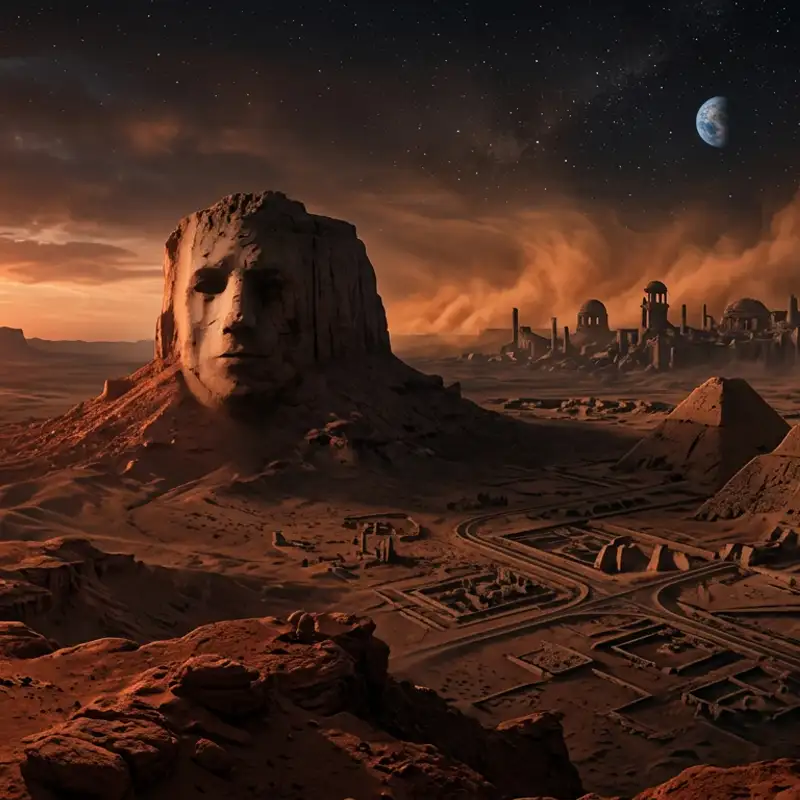
We are going to talk about Mars, about
a face that looks against the sky, about
pyramids, about glass, about traces of machinery, and
about a planet that disappeared for millions of
years ago.
We are going to talk about the astronomer
Thomas von Flandern, the man that says that
NASA is lying, that Mars is an old
moon, and the humanity origins from an exploded
water world.
In order to do so, I have created
a virtual edition of Thomas von Flandern.
The problem is, with this interview here, is
that Thomas von Flandern died in 2009, so
in order to hear his evidence, in order
to his predictions, and his conflict with the
establishment, I have created this person.
It's a virtual Thomas von Flandern, and everything
he says is based on me.
But this is going to be a good
edition, so find a good chair.
This is going to be a long road,
a long journey to Mars, and perhaps back
again.
Thomas von Flandern is not nobody.
He was an astronomer, and he was not
some person with self-taught education with a
binocular in the backyard.
He worked for the United States Naval Observatory,
one of the world's most respected astronomical institutions.
He was an expert in space mechanics, especially
in measuring time with astronomical methods.
He won prizes, he was respected, and he
was mainstream.
But then he started looking at pictures from
Mars.
In order to understand why Thomas von Flandern's
history is so fascinating and controversial, we have
to go back to 1976 with a picture.
It was taken by the Viking 1 Explorer,
and it was taken about an area on
Mars called Cydonia.
In the middle of that picture there was
a hill that in the dimming afternoon light
looked like a human face.
The majority said, this is only light and
shadows, random.
Thomas von Flandern said, let's research this, and
so he did for the rest of his
life.
But before we get to the face, we
need to spend a few minutes in order
to understand who Thomas von Flandern was, because
this is important.
He was not a crank.
He was not a lunatic.
He was a well-educated astronomer who refused
to close his eyes for something he could
not explain.
I was born in 1940 in Cleveland, Ohio.
I was always interested in the space, in
the sky.
I read physics and astronomy at Xavier University
and later on Yale.
My PhD was about astronometry, about measuring stars'
position with extreme position.
I was good at it.
I was headhunted to the Naval Observatory, where
I was one of the unsung heroes in
the official almanac regarding space.
For years, Thomas von Flandern was one of
the unsung heroes.
He helped in mapping the Moon for the
Apollo missions.
He developed methods in order to predict planetary
orbits with unseen position.
His colleagues respected him.
But when I started to ask questions, for
instance, how comes that our models of the
solar system's age does not match the observations?
There was always small differences, and nobody could
explain the asteroid belt in a convincing manner.
There were thousands of small pieces between Mars
and Jupiter.
The standard explanation was that there was a
planet that never formed.
It gave no meaning for me.
The explanation that the asteroid belt is a
planet that never formed is actually still the
most widespread explanation of today.
A planet is created in a dish of
dust and gas around a young star.
The materials are grouping together, and the gravity
of Jupiter prohibits that the material could create
a full planet.
Or, should I say, this is what you
read in school.
Von Flandern rejected that.
There is too much material.
This can only be left over.
And the composition is wrong.
If there was a planet that never was
fully developed, we should expect a mix of
different kinds of stones.
But the asteroids are very different.
Some are with iron.
Some are with stone.
Some are with carbon dioxide.
It looks like the remains of something that
was finished and then was smashed.
And it's here...
And it's actually here that in this so
-called exploding planet hypothesis comes in.
The idea is not new.
It was actually proposed already in the 18th
century.
The hypothesis problem was named Pateron after Greek
mythology where Pateron was the son of the
sun god that lost control over the sun
god and then was killed by Zeus.
Von Flandern relived the idea and gave it
scientific value.
So let's take a deep dive into Von
Flandern's, should we say, main theory.
He meant that for about 3.2 million
years ago, there was a big planet between
Mars and Jupiter, and that planet exploded.
That planet, let's call it Pateron or whatever
you like, was about the size of the
Earth or perhaps a little less.
Mars was not originally a planet.
Mars was the moon for exactly this planet.
Imagine a solar system with an additional planet.
It lies between Mars and Jupiter.
It has perhaps two moons.
One is Mars.
The other one is gone for a long
time ago.
But then it explodes.
What happened?
Von Flandern had a list of about two
dozen evidences of these explosions.
I will go through the most important ones.
The first evidence is perhaps the most important
one and that is that Mars has two
faces.
Mars is like two planets set together.
One half, the south, is covered by craters.
It's old.
It's haggard.
The other half, the north, is flat like
a pancake.
It is the flattest surface in the entire
solar system.
Perhaps, except for these areas that are covered
by ice, the Earth's cost on that side
is only about one kilometer thick.
On the crater side, it's more than 20
kilometers thick.
Imagine a tennis ball where one half is
squashed by a giant hammer and the other
side is entirely slippery.
This is Mars.
The standard explanation is a gigantic meteor coming
for a long time ago, perhaps from a
planet about the size of Pluto, created this
big perilous basin on the northern half.
That is called the giant impact hypothesis.
Von Flandern rejects that.
An impact will leave a crater, not an
entirely flat northern hemisphere.
And that will not explain why the other
side is extremely cratered.
No.
This looks like something that was hit by
an explosion from one side.
Imagine a moon that is close to an
exploding planet.
The shockwave hammered on one side blows away
the atmosphere, moves the Earth crust together, and
the other side is untouched.
Then we have the polar shift.
And that is that Mars has tilted dramatically.
The next evidence is about the polar shift,
about how Mars has tipped dramatically.
Planetarian geologists, mainstream scientists, etc., who does not
believe in exploding planets, found evidence for that
Mars' rotation axis changed up to 90 degrees.
And it happened instantly.
There was no pulse between.
It was a jump.
It was exactly what you would expect if
a giant explosion on one side of the
planet was tipping the tilt.
Just like setting an additional weight on a
spinning top, it will fall instantly.
To set this in perspective, if Earth is
tipping 90 degrees, then the North Pole suddenly
will be about equator, and New York will
have midnight sun in winter and polar night
in summer.
That would be catastrophic.
The third evidence is the atmosphere where we
have CN 129.
And that is one of von Flandern's, should
we say, favorite evidences.
And that is also one of the hardest
to explain in nature.
The atmosphere of Mars contains an unusual high
concentration of CN 129.
This is an isotope that is created by
nuclear fission.
So, when heavy atoms like in uranium react,
that happens in atomic reactors, in atomic bombs,
and in supernovas.
But there was no supernova nearby.
The only explanation is a giant explosion.
Perhaps naturally, perhaps artificial.
But the fact is that it has released
an enormous amount of fission products.
And Mars has more CN 129 than somewhere
else in the entire solar system.
NASA has a different explanation.
They say that CN 129 can be created
over time by cosmic radiation that hits the
atmosphere of Mars and then builds up in
the atmosphere.
But von Flandern rejects this.
The amounts are too big.
The distribution is wrong.
This is not cosmic background radiation.
This is a fingerprint of an explosion.
The fourth one is the atmosphere of Mars.
It's thin, basically.
Today, Mars has an atmosphere that is about
1% of the Earth.
It's almost a vacuum.
But there is solid evidence that it was
once a lot thicker.
That we have river dales, we have minerals
that only creates in water, and so on.
What happened to the atmosphere?
The standard explanation is that the solar wind
has blown it away for millions of years.
But this takes times, much times.
Our calculations show that the atmosphere disappeared way
too fast.
It looks like it blew out.
An explosion that more or less took the
atmosphere of the planet.
Just like when a balloon is exploding.
The fifth and last evidence that I will
cover in this podcast is the
March orbit.
This will be a little technical.
But Flandern pointed out that the orbit of
March is not what it should be if
the planet always has been orbiting the Sun.
March's eccentricity, actually how oval its orbit is,
is higher than you would expect from an
old planet.
There are small uncertainties in its orbit.
It's exactly what you would expect to see
if an object was thrown from another orbit.
In this case, an orbit of an exploding
planet.
So, if we sum it up, von Flandern
thought that March was a moon, the exploding
planet that might was Patern, and that explosion
happened 3.2 million years ago.
And then something happened with March, a polar
shift, an atmospheric crash, and then the surface
of March was divided by two.
But there's more, much more.
And now we are close to the main
critics in von Flandern's theory.
Because if there was a civilization on the
exploding planet, or March itself, then they would
have left traces.
Von Flandern says yes, and the most, what
are we calling it, the most famous trace
is the face on March.
The face on March has always had bad
press.
It was called a joke, an object illusion,
a result of low picture quality.
But let me read up what von Flandern
said himself.
In 1976, when the Viking orbiter sent home
pictures, there was a picture from the Cydania.
In the middle of nowhere, there was a
hilltop with two eyes, a nose and a
mouth.
That is not extraordinary.
That is not a perfect face, but it
is a face.
I thought, hmm, let's do a test.
And this is important.
Von Flandern was not convinced in 1976.
He was skeptic.
He actually proposed two tests to measure if
it was artificial or not.
I said, if something has built it to
look like a human face, they would have
built it upright.
But the Viking explore picture is different.
And furthermore, they would have placed the face
close to equator, so it could be seen
from all directions.
But Cydonia is about 41 degrees north.
That is random, but I initially fought against
the artificial origin.
So Von Flandern was not a naive believer.
He was a scientific person.
He was a science man.
So he used his own test, and then
something happens.
In 1996, Von Flandern was in a radio
show and talking about the exploding planet hypothesis.
A listener wrote an email, and that email
changed everything.
The listeners wrote, if you are right about
an explosion from 3.2 million years ago,
and if there was a pole shift on
Mars at that time, then the face must
be built before the pole shift.
So, where was it then?
That was a genial question.
I took my Mars globus, found the old
pole position, some normal geologist has mapped, and
I moved the distance from the old pole
to Cydonia.
That was 90.1 degrees.
That was exactly equator.
Think about it.
If Mars was tilting 90 degrees, then equator
will move.
Cydonia was on the old equator, and when
Von Flandern draw the old equator in the
picture, then the face was suddenly upright, reaching
2 degrees.
So, with my ion 2 test, I have
used to argument against our physical origin, now
the turning.
If the face was built before the catastrophe,
it will be upright according to the old
equator, and it was an equator.
Both criteria was fulfilled.
The odds against this was about 1000 against
1.
Von Flanders was shaken.
He realized that he could no longer stand
passive, so he changed his view.
He was now convinced that the face could
be artificial, but he was also a scientific
person.
He knew that you could not conclude something
from just one picture that was also blurry.
You have to do assumptions.
So he did a priori assumptions.
And this is an important scientific, should we
say, lesson.
Von Flandern used something he called a priori
principle.
So listen carefully, because that is the key
for his entire argumentation.
In science, you separate between a posteriori, what
you see after, and a priori, what you
predict before it happens.
If you see a pattern after that, you
cannot trust it.
Random things happens all the time.
But if you predict something before you see
it, and then it goes as you predicted,
then you have an evidence.
So, Von Flandern used, what are you calling
it, card game illustration.
Imagine that you have 13 cards in bridge,
and you get them all in, I don't
know, spa.
So you got the entire color.
You think, mind, this is unlikely.
The odds are 635 billions against one.
But this is actually against a certain set
of cards, on 13 cards is unlikely.
The thing is that if you're only using
spa, then we have put in some kind
of meaning.
I did use the Danish word spa for
spades.
I did mean spades, sorry for that.
But let's go on.
If you go to the table, and on
the table says, I predict that I get
all 13 spades, and then it happens, then
you can be sure that something is cheating.
This is a prairie, that is evidence.
So, in 1997, when the Mars Global Survey
Explorer was sending new pictures of the phase,
von Flandern and his colleagues in SPSR, Society
for Planetary CGI Research, a list of a
priori predictions.
If the phase was artificial, meaning that it
was built to look like a human phase,
what will you expect to see in high
definition?
We predicted four things.
We predicted four things.
One, an eyebrow about the eye, an iris
made inside the eye, nostrils at the end
of the nose, and lips were separated, not
just a line.
Each of these features has to be in
the correct size, the correct shape, the correct
position, and the correct orientation.
And they must not appear anywhere else in
the hill.
Otherwise, one could simply pick out random features
that happens to resemble something.
It's important to understand just how specific these
predictions were.
They did not say maybe it looks like
something.
They said a high resolution, we will see
a curved eyebrow about in the left eye
socket, a circle inside the eye socket, two
small circles at the tip of the nose,
and a horizontal two-part structure at the
mouth.
We calculated the odds for each detail and
then we combined them.
The odds for these four details will occur
randomly.
In exactly the right position is 1,000
,000,000,000,000,000,000,000,000
,000,000,000,000,000,000,000,000
,000,000,000
,000,000,000,000,000,000,000,000
,000,000,000,000,000,000,000,000
,000,000,000,000,000,000,000,000
,000,000,000,000,000,000,000,000
,000,000,000,000,000,000,000,000
,000,000,000,000,000,000,000,000
,000,000,000,000,000,000,000,000
,000,000,000,000,000,000,000,000
,000,000,000,000,000,000,000,000
,000,000,000,000,000,000,000,000
,000,000,000,000,000,000,000,000
,000, Then came the new image in 1998.
Mars Global Surveyor flew over Cydonia and the
image was sent back to Earth.
We were excited and nervous.
The image was taken under very poor conditions.
the spacecraft was not about the face it
was far to the west so we saw
it from an oblique angle almost in profile
the light was also poor the Sun was
coming from below it's like you're holding a
flashlight under your chin that is the worst
possible lightning for seeing a face despite that
front lantern saw something about the left eye
socket there was a triangular formation exactly where
an eyebrow should be inside the eye socket
there was a circular formation an iris and
the end of the nose there were two
circular formations nostrils and the mouth considers us
to gibberish lips all four predictions were fulfilled
front lantern was convinced he later wrote that
the natural origin was ruled out with odds
of 1,000 trillion trillion to one he
even said that the artificial was proven beyond
any reasonable doubt but then something strange happens
with the image was released to the press
it looks nothing like the image front lantern
has seen and that is one of the
most controversial parts of front lantern theory when
NASA and the jet propulsory laboratory called JPL
released the official image to the news media
it looks completely different what front lantern calls
the real image with eyebrow iris nostrils was
never shown in the newspapers instead a blurred
smidge image was shown that looks like a
pile of rocks it was manipulation not necessarily
a conspiracy but people who thought that they
were doing the right thing the image has
been run through a high-pass filter in
Photoshop then a low-pass filter and then
the average between the two each filter remove
details together they remove almost all information the
resource was an image that was useless front
lantern was site the Adobe Photoshop's definition of
a high-pass filter it retains the edge
detail where there are a sharp color transition
and suppress the rest of the image in
other words it enhanced the outlines and remove
the soft gradients needed to see a face
why did they do it JPL's public information
office wanted to kill the story the astronomer
Michael Marlin who was the responsible of the
camera has been publicly said that he personally
felt offended at having taken the image he
called it a blow to the integrity of
science and waste of public funds they didn't
want the public to get the wrong idea
so from front and claims that JPL staff
choose to the manipulated image special special especially
because it would make the story disappears this
will kill the story they are lit they
allegedly said and it did I will give
them the benefit of the doubt they thought
that they were going to do the right
thing but God save us from people who
think that they're doing the right thing for
us science is about showing data not protecting
the public from wrong ideas critic argues that
von Flanders is all in simple interpreting this
they point out that JPL image processing by
standard procedure to enhance contrast in spacecraft imagery
not something malicious and that is the real
image from Flanders refers to has also been
processed just differently the face wasn't the only
thing in his lectures from Flanders and represented
a wide range of images showing other formations
that he believed was unnatural let's go through
one of the most striking first we have
the pyramid structures in the Cydonia region near
the face there is a group of pyramid
like objects we call them the city complex
some are four sides some are five they
have sharp edges not rounded like natural mountains
and they are arranged in a pattern that
is not random one of these objects is
called DNM pyramid from Flanders shows in an
image that on the backside of this pyramid
has a formation that distinctly resemble an entrance
I won't speculate too much but when we
one day get ground truth when we can
go there this is one of the first
places I would investigate then we have triangle
triangles everywhere from Flanders compared March to moon
on the moon there is a crater called
a cura crater this is a slightly triangular
and one of the best example of an
natural triangle in the solar system apart from
Earth and Mars on Mars we have hundreds
of triangles that are far more perfect than
the cura some are elevated plateaus shaped like
triangles others are mist triangles six levels deep
all sharing the same apex and almost always
there is a crater at the apex it's
a pattern that repeats too often to be
random and if we go on one of
the strangest phenomenon on Mars is the glass
like streaks and tubes across the planet you
see long parallel white streaks on the surface
but where the surface is broken in cracks
and frictions you can see what lies beneath
there are tubular objects that are transparent you
can see through them they reflect like glass
and metal in the shows
from Flanders shows image of these tubes crossing
on each other in networks sometimes in right
angles sometimes in woven across patterns he argued
that this is very difficult for natural processes
to create things like that and then we
have vehicle tracks there are many places on
Mars where you can see long straight tracks
the standard explanation is just devil tracks small
tornadoes that leave streaks but at higher resolution
you can see the details in the tracks
almost fret like marks like from tracked vehicles
and the tracks has a strange tendency to
pass tar gently around craters they just barely
goes around them but they will does not
do that then we have vegetations one of
the most striking images from Flanders presented in
his shows it looks like a tree seen
from about a central trunk with bracing structures
casting shadows this object may be 200 meters
across and 80 meters tall it casts shadows
so it stands about the ground the original
explanation was crystal growth but crystals don't cast
shadows like that it looks like a tree
Arthur F.
Clegg the famous science fictions writer saw this
image and said that he was 95%
certain that there's been extensive vegetation or something
equal in Mars so what does the scientist
says to this so now we enter the
cold scientific reality because of Flanders theories however
fascinating have been made with strong criticism first
of all pareidolia the brain see faces everywhere
this is one of the most common explanations
the human brain is extremely good to recognize
faces but this also means that we see
faces where there are none in clouds mountains
even in electrical outlets the skeptic says from
Flanders evidence is a classic case of pareidolia
pareidolia is not explanation in a priori predictions
you cannot see an iris if there is
none you cannot see nostrils if they don't
exist we predicted these details and they were
there this is not pareidolia this is data
another criticism is from Flanders himself that he
manipulated these images he used fuselage shops to
adjust lightning and perspective exactly what he accused
JPL of doing the difference is that the
JPL version was called manipulation while from Flanders
was called reconstructions the skeptic says from Flanders
created a double standard when he had just
contrast lightning and perspective it's necessary to see
the truth when NASA is doing it it's
manipulation the truth is both versions are preceded
sorry are processed images the raw spacecraft data
is just meaningless shades of gray everyone has
to process them the perspective is intent we
use global adjustments lightning angle perspective to create
what a human eye would see JPL uses
filter that is actually remove details it's not
the same then we have the exploded planet
where they say that physics does not work
that way this is perhaps the most serious
criticism planets do not explode to destroy a
planet at the size of the earth that
would require an astronomical amount of energy literally
it would be comparable to a supernova and
there is no evidence for a nearby supernova
3.2 million years ago physicists would say
something like that from Flanders exploding planet hypothesis
is a massive physical problem first what causes
the planet to explode there is no known
mechanism second if it exploded the fragments would
be not gather in the asteroid belt they
will be shattered across the entire solar system
third March would have been completely destroyed it
if it was too close to such an
explosions it would not survive as an intact
planet the mechanism could be natural for instance
a chain reaction in the planet core or
the physical if there was an advanced civilization
we don't know but we do know that
there are craters in the asteroid belt voids
where the materials are missing this is exactly
what you would expect after an explosion and
then the dating does not match from Flanders
has dated the explosion to 3.2 million
years ago using what he called purely astronomical
dating method but other researchers has examined the
same data and has found it much younger
or much older ages mainstream science would say
there is no consensus that everything dramatically happened
3.2 million years ago in the solar
system the March pole shift can be dated
very differently times depending on the method used
some say 10 million years ago some say
100 million years ago from Flanders choose a
number that fits his theory that is not
correct we used multiple independent methods all pointed
to 3.2 million years ago and it
matches the Lucy fossil on earth it's too
perfect to be a coincidence then we
have the conflict with relativity Flanders also held
a controversial view on physics he argued that
gravity must act instantly not limited by the
speed of light this directly contradict Einstein's theory
of reality which has been confirmed in countless
experiments mainstream science just like Steve Calleb would
say something like from Flanders misunderstood relativity he
believed that gravity must act instantly to maintain
stable orbit but it doesn't it's propagate at
the speed of the light the GPS system
which he himself used as evidence actually depends
on relative realistic corrections his argument is based
on outdated understanding of the physics I have
great respect for Einstein but data is data
there are anomalies in mercury orbit that relativity
does not explicitly explains it's simply saving that
we should keep the door open for other
possibilities now we move into from Flanders the
part of from Flanders theory that felt most
like science fiction if there was a civilization
that built the face who are they and
why would they do it we believe that
the parent planet the one that exploded was
a water world meteorized from the asteroid belt
show signs of having been in contact with
water some of them is basically clay that
required liquid water over a long period so
the planet was likely habitable perhaps even a
water world like the film interstellar from Flanders
imagines that this civilization knew that a catastrophic
was coming perhaps they have advanced technology enough
to predict the planet destructions and they choose
to build something that could survive who built
the face on Mars think we know our
own exploration of the moon might look in
thousands or 10,000 years we have scientific
basis tourist attractions maybe even amusement parks when
you orbit the moon you will look down
and see large structures built to seen from
above this is exactly what Cydonia looks like
a theme park, a museum, a monument from
Flanders pointed out that the face looks human
not alien not insect like not animal hominid
face and the thing 3.2 million years
ago is exactly when Lucy lives in Africa
the oldest secure hominid fossil as far as
we know our human lineage began around that
time the same time that the civilization on
Mars ended is that a coincidence?
From Flanders suggested that survivors from the exploding
planet may have reached Earth that we humans
are descendants of the civilizations that we are
the Martians in a literal sentence.
There's an ironic twist in H.G. Wells'
War of the Worlds.
In the book the Martians came to Earth
to conquer us but maybe the truth is
that we are the Martians we came here
from Mars or a parent planet and forgot
everything until now.
And this is the point where we have
to go a step back there is no
genetic evidence that humans come from Mars our
DNA is unequally terrestrial we share genes with
the apes with the yeast with the fruit
lines if we came from Mars our DNA
would be fundamental different it isn't but from
Flanders is not a geneticist he is an
astronomer he looked for landscape not molecules.
So the legacy what happened to Flanders?
From Flanders died in 2009 at the age
of 69 in his later years he became
increasingly marginalized by the scientific establishment his papers
was rejected his theory was ridiculed but he
did not back down I don't care what
people say about me I don't care if
they laugh I have seen the data I
have calculated the odds I know what I
saw in 50 years in 100 years they
will realize that I was right.
The question is will they?
So far the answer is no.
None of the core claims have been confirmed
by later Mars missions.
The phase newer image from the Mars reconnaissance
orbiter shows an eroded hill not a phase.
The pyramids likely natural missions the glass tubes
probably optical effects as particular reflections from a
smooth mineral surface but from Flanders left a
legacy not necessarily scientific but cultural.
He helped popularizing the idea that the Mars
might hold signs of intelligence.
He inspired amateurs UFO enthusiasts and skeptics of
institutional authority and maybe just maybe there was
something healthy in that.
As of 2026 we have sent more missions
to Mars than ever before.
The perseverance rover is collecting rock samples Chinese
and European spacecraft orbiting the planet and SpaceX
talks about sending humans within a decade.
None have found evidence for von Flandern theories
but they have found something else.
Mars once have liquid water rivers lakes maybe
oceans organic molecules the building blocks of life
has been detected and methane has been found
in the atmosphere.
No phase but the questions of life is
more open than ever.
If they find microbial life bacteria people will
say see von Flandern was wrong but microbes
are the beginning they are the microbes then
there was probably something larger and if there
was something larger then my phase may not
been so crazy after all.
Von Flandern has had a way of turning
everything into around even the counter evidence became
support that was both his strengths and his
weakness.
So where does it leave us?
On one hand a skilled astronomer that asked
bold questions made predictions and changed consequences and
the other hand someone who crossed the line
between hypothesis and conviction who saw patterns others
could not see and who frosted his own
interpretation more than the broader scientific community.
And the community says almost unanimously there is
no phase there is no pyramids there is
no exploding planet but science has been wrong
before.
Continental drift was rejected for decades.
Methyl impact that once was dismissed as the
cause of the dinosaur extinctions.
Sometimes stubborn thinkers is right.
Will von Flandern be one of them?
We don't know but we know for certain
that until we stand on March until we
dig into the Cydonia until we test this
formation directly until then let's keep the door
open.
Man will occasionally stumble over the truth but
most of the time he will pick up
himself and continue.
That was Winston Churchill.
Don't get up too quickly look at the
image think for yourself.
Thank you for listening.