
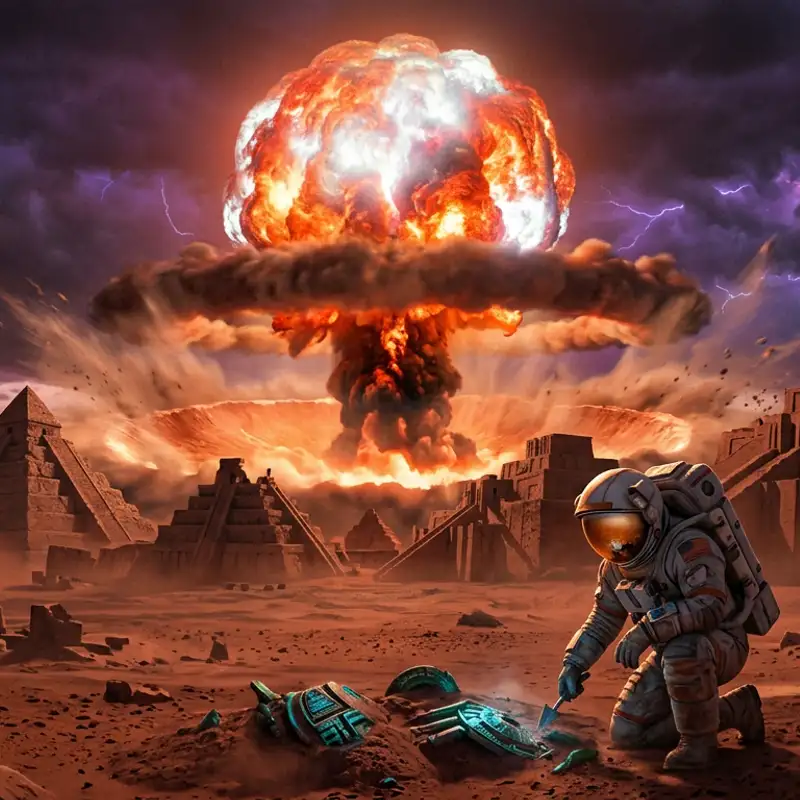
Hello and welcome back. Today is Sunday and hereby time for another edition of
the podcast. Today we are going to do a deep dive in one of the most
controversial and thought-provoking figures in alternative planetary science
Dr. John E. Brandenburg. Many of you know him as the guy who found the ocean on
Mars or the one that talks about a nuclear war on one of our neighboring
planets, but who is he really? Brandenburg is not some random conspiracy
theorist sitting in his mother's basement. He holds a PhD in plasma
physics. He works at Lawrence Livermore National Laboratory, one of America's
primary weapons labs, under none other than Edward Teller, the Hungarian-Jewish
physicist who invented the hydrogen bomb. He worked at Sandia National Labs on
directed energy weapons. He has been a consultant for the Pentagon and the
Intelligence Agency and he holds patents on a microwave electrothermal thruster
that has actually flown in space. So when this man says he has found evidence of
a dead civilization on Mars and that it is wiped out by a nuclear weapons from
space, it is worth listening, not necessarily to believe him, but to
understand the arguments because they are more sophisticated than you might
think. Today we are going to unfold his argument layer by layer as he presents
them in two of his books and a couple of interviews that I found on the Internet.
So I will use the same format as I've done earlier, so that means that when I
read the citations of John E. Brandenburg, my voice will sound like this in order to
differentiate between me and Dr. Brandenburg. So, back on track. We are going to
understand how a plasma physicist ended up weeping in his office over a
civilization that died 250 million years ago and we are going to look into
what mainstream science actually says about all of this. To understand
Brandenburg's drive we have to understand his mental state in the beginning of the
1980s. He was not a cold, detached academic. Curiosity examined some
pictures. He was a man in a deep existential crisis. Image working at
Sandia National Labs in 1983. This is where the United States developed its most
advanced weapons. You are surrounded by people designing the future of warfare.
And then the nuclear winter theory survived, developed by Carl Sagan and
others. Ironically, based on observation during dust storms on March. Brandenburg
described the mood of the lab with an anecdote of one of his office mates.
My office mate turned to me one day and blurted out that he has been planning to
run home, grab his family in case of a nuclear war and then head for the hills
to try to survive. But now, because of this nuclear winter that was in November
1983, instead of heading for the hills he said he was going to climb up the roof of
his house with a six-pack of beer and watch for the whole thing to go.
That was not a joke. That was despair. At the same time there was the Apple Archer
crisis in 1983, November. A NATO exercise that Russia misinterpreted as
preparations for a real attack. We were, according to Brandenburg, as close to a
nuclear war as in the Cuban Missile Crisis. But this was secret. Only people
inside the fence of the lab knew how bad things really were. Then comes Christmas
break. In December 26th, Brandenburg sees a TV program about the phase on Mars and
suddenly hope ignites in him.
I remember putting my little daughter to bed with a bedtime story and suddenly I
found myself full of hope that perhaps a big discovery like this, that there has
been a dead civilization on Mars, would end the Cold War. The Russians and the
United States would together go to Mars in search of other things. I could see a mental
pathway out of this Mexican standoff we had become involved in.
It's crucial to understand Brandenburg's Mars research is motivated from the very
beginning by a deep, almost pacifistic desire to save humanity from itself.
He thought, if we can show both superpowers what happened to Mars, a
planet that once resembled Earth but is now a frozen desert, they will wake up
and stop this madness. That was the emotional engines that drove him into
the independent Mars investigation. Brandenburg joined a group led by
Richard Hoagland in Silicon Valley. They used data tapes from the Viking
missions and quickly found something remarkable. The phase and the pyramid at
Cydonia Mensa in the northern part of Mars. But there is a core argument. NASA
never showed them together.
NASA never showed the picture of the phase beside the pyramid together
with another public photos because it becomes obvious, really. We are looking
at archaeology. They are only five miles apart. Later we found that the Viking team
originally wanted to land there. It was the River of Mars. But they suddenly got
overruled by a group that they didn't even exist in the project. The boys
downtown say, you can't land there. Cydonia has been declared too rocky. It
wasn't too rocky. It was the fact that the face was there and the pyramid was
there. That is the key argument for Brandenburg. Not only are the structures
there, but NASA has taken active steps to avoid documenting it properly. He says
the boys downtown and that refers to intelligence agencies. NASA is, in his
word, a hood ornament on mysterious black sedan which the wheel space program
reels. But Brandenburg did not stop at Cydonia. He and his colleague reasoned, if
Cydonia was on the shoreline of the Northern Ocean, there must have been
other cities along the coast. They ordered pictures from the other side, the
halfway around the planet, same latitude, sight unseen, and they found two more
phases in the area now called Galaxus Chaos. And this is when Carl Sagan
entered the picture. Carl Sagan actually called me on the phone. He said,
Brandenburg, why are you causing this trouble? I was deeply honored, but the
conversation was actually basically, why are you causing trouble? Later we found a
second phase. He called again and apologized for being short with me and
asked for the pictures. I stuffed them in a bunch of photos in an envelope addressed
to Carl Sagan, Cornell University, Astronomy Department, and I mailed them. I
actually watched the mailbox truck take it away. When I moved to Washington DC
and was called to follow up, we played telephone tag for two weeks. Then I
finally caught him and he said, I never got them. There was a long pause. I know
what I put in that envelope. What happened to the envelope? Brandenburg strongly
implies that it was intercepted. Shortly after, the area was renamed to Galaxus
Chaos, a name Brandenburg interprets as an inside joke. Someone threw somebody's
galaxy into chaos by finding a second phase. And there is the crucial point.
Brandenburg says that Sagan, the great skeptic, ended up admitting that the
second phase, smaller than the first, was very interesting. This is not exactly a
full conversation, but it is as far from the total dismissals as you might expect.
Let's talk about the border, because here Brandenburg actually has a fair amount of
mainstream science on his side, even if he feels stumped.
I was the one to find the Martian ocean. If you look up Mars ocean theory on Wikipedia,
I am reference number one. I was the first person to propose that there is a
scientific meeting with evidence. I gave my paper to a scientific
conference in 1986 to a room full of Mars scientists, and yet nature never
mentioned my name. It should be called the Brandenburg ocean. I just call it
paleo ocean of Mars, but it should have been called Brandenburg ocean.
His method was elegant in its simplicity. By studying elevation maps from the Viking
missions, he found that a particular contour line called zero kilometer
wrapped all the way around the planet, about the line in the term is rocky and
rock below is smooth like ocean bottom. All the river channels on Mars feel into
that percent. For Brandenburg, this conclusion is inescapable. There was an
ocean, and the notion means the possibility of life. This is where the
controversial results of the Viking missions come in. In 1976, the two landers
conducted experiments to find life in the soil, specifically labeled a release
experiment designed by Gilbert Levin. The results was positive. The soil produced
gases exactly as you would expect if it contained metabolizing
microorganisms, but NASA rejected it because another experiment failed to
find organic molecules. Brandenburg's argument is that NASA now has been
caught by its own logic. They say we didn't find life on Mars because there
was no organic matter in the soil. Now they found tons, billions of tons, of
organic matter on Mars. Mars is covered with organic matter as if it were a
living planet. The planet is still alive. It breathes oxygen and methane. We know
there's an active biosphere there, and by the way, the color of the planet on Mars
would not have been green like on Earth. It would have been red because if you
grow plants in dim light, like on the ocean floor, they alter their chlorophyll to
make it red so it absorbs energy more efficiently. Mars is partially red
because it's alive. And now we are coming to the nuclear bomb signatures, and that
is, the core of the matter, one of the most sensational and most controversial
claims. While Brandenburg was working at Sandia Labs, he was standing in line at
the Ceres machine one day, chatting with a colleague about a strange isotope on
the Martian atmosphere. I mentioned it to a guy in the line next to me that Mars
has a very unusual pattern of isotopes. On Earth, Xeon-129 and Xeon-132 is almost
exactly equal, but on Mars, there was two and a half times more Xeon-129. His face
suddenly left all of his composure, and he said, someone nuked them. I was stunned.
At Sandia, they had a department that monitored the atmosphere for signs of
nuclear tests, and he was basically telling me that there was a nuclear
weapon signature in the Martian atmosphere. Let's pause here and
understand what science is behind this claim. Xeon-129 is a stable isotope. It
does not decay. It is formed by two processes, supernova explosions and
hydrogen bomb explosions. We know there is no supernova on Mars. If there has been
one, there will be no solar system left, and we will not be there. So that
leaves hydrogen bomb explosions left. In addition, there is Argon-40. When
potassium in rocks irradiates with neutrons, a classic byproduct of nuclear
weapons, Argon-40 is formed. Mars has a huge overabundance of Argon-4 in its
atmosphere. Brandenburg's argument is simple. Two independent isotopes are
normally both points to the same cause, massive thermonuclear explosions. And then
there is the forensic evidence that is stable and measurable. The consequence
among real experts on isotopes, not just on Mars, but on other planets and
meteorites is there is no explanation for this superabundance of Zeon-129 or
the Argon-40. I have reviewed the literature very carefully on this. You
can imagine me sticking to my neck out as a scientist, but I found that the
experts agree there is no natural explanation. He goes into quantified the
catastrophe. That was just not one bomb. It was the equivalence of the entire
nuclear arsenal on Earth detonated at once. Two hydrogen bombs, each as big as
the Empire State Building, dropped from space, airburst about 20 kilometers above
the surface. And notice the radioactive hotspots, you know, the locations with
elevated concentrations of thorium and potassium has no craters. If this were
natural uranium deposits that has gone critical, something we've seen on Earth
like the Oklo reactor in Gabon, which I covered previously in this podcast, they
would be massive crates. Brandenburg's conclusion is that the explosion happened
in the air exactly as you would design a hydrogen bomb to maximize destruction.
Here comes the emotional core of the story.
When it hit me, I was sitting in my office. I wept like a child for about four
or five minutes, because they were all dead. I looked at it at the German nuclear
Holocaust, and it happened up there, and we were so afraid that it could happen
on Earth. After a few minutes, I said, get hold of yourself, don't be sad, be happy,
because now you know that the universe is not... has a safety net.
Bad things happens in the universe, so make sure that it doesn't happen here.
This reaction is crucial to understanding Brandenburg. He is not a
co-scientist selling books about aliens. He is a man who, on the basics of isotope
data and images, generally believes that he discovered a genocide on a cosmic
scale, and it broke him. But it also gave him a new purpose, to warn humanity so we
do not end up in the same way. So, why is this not on the front page of every front
page on papers, etc.? Brandenburg's answer is twofold.
By erotic self-interest at NASA, combined with an 80-year-old UFO cover-up, on the
prerogative level, he explains that it will be an anecdote from a Whitley
Strieper. One of the managers of Jet Propulsion Lab said to the other
managers, don't you realize that life on Mars means death for JPL? Because
that means that all the money will go to human spaceflight and not robotics.
It's Houston versus Pasadena. Mars is right now a kind of all-you-can-eat
buffet for Jet Propulsion Lab. But I don't think that is just that. There is a
chilling effect on the American science from the UFO cover-up. And then there is
the UFO cover-up. Brandenburg tells a personal story. I asked the colonel on
the staff of the Joint Chief, a friend of a friend. But I spoke directly to him. Is
there really a UFO cover-up? And he said, yes. He says, and that's all I can tell
you. The rest you can figure out yourself later. I called Spain command and say, I
heard there is an extraterrestrial threat. Those existence is classified. I
would like to help with that program. And they said, okay, let me see if I can make
you with somebody. We have to call you back on that. And out of this grew
Brandenburg's theory on the Mars disclosure. He believes that the
government, especially after the 3I Atlas Oumuamua incident, realized that it needs
to prepare the public for life in space. But they wanted to do it gradually, not
catastrophically. Step one, acknowledge microbiological life on Mars, which Bill
Clinton almost did in his 1996 with the ALH84001 meteorite, but it fizzled. Step two,
send astronauts to Mars to confirm it. Step three, find the archaeology, the
pyramids. Step four, uncover what happened to the civilization. Mars is a gift for
the US government. It is a way to do disclosure without talking about the UFO
problem, because the civilization is dead. They can't invade us. They look
primitive, like bronze age, and they look like us, and they are dead. Did I forget
to mention they are dead? That means that we can go to Mars and find out what
happened, so we can make sure it does not happen on Earth.
This is the ultimate argument, and it's difficult to discuss, sorry to dismiss it
on a strategic level. If you are a government wanting to acclimate the
population to the idea of life in space, a dead humanoid civilization on Mars
is the perfect soft entry. There's no threatening. It validates our own
significance, and it provides a moral justification for becoming a space-faring
civilization. So what does the traditional science say to all this? So I
have tried to compile different arguments from the traditional, or for
the mainstream science argument. First of all, there's the phases and the
pareidolia. Brandenburg himself mentions the concept and calls it reverse
hallucinization. Denying a pattern is there because the implications is
unacceptable, but the scientific explanation is the opposite. If the
human brain is hardwired to recognize phases, then we see them in clouds and
toast and hill formations and all over. Newer image from Mars reconnaissance
orbiter shows that the phase is a natural measure, a flat top hill, that
from the other angles and under different lightning conditions does not
look like a phase at all. Brandenburg's counter-argument is that
he has seen it from multiple angles, including morning illuminations, and it
has symmetry holes. But the critics say that this is subjective. Second, there's
the water and the ocean. Here Brandenburg is actually aligned with the
mainstream science. Most planetary scientists agree that Mars has had a
liquid water and likely another ocean. The disagreement is over why it
disappeared. The mainstream explanation is atmospheric stripping. When Mars'
magnetic field died because of the planet's smaller mass, it caused it to cool
faster. The solar wind simply blew the atmosphere away over hundreds of
millions of years. Nothing suggested a sudden catastrophe. It was a slow
suffocation, not a murder. Third, there's the isotopes. Here the scientific is
crux. Brandenburg claims that the CN-129 and the Argon 40 anomalies is
inexplicable without nuclear weapons. Mainstream research has proposed several
mechanisms. First, Xeon-129 could be a remnant from the planet formation
differentiated in the mantle and then released over time. Argon 40 forms
naturally through radioactive decay of potassium 40, which is present
in all rocks. A higher concentration on Mars could be due to the planet's
geological history and not to a neutron bombardment. Some researchers point
out that Mars' lower gravity means lighter isotopes escape to space more readily,
altering the isotope rotations without any explosions. Brandenburg dismisses
this explanation with the argument, there is no crater at the hotspots. But critics
would respond, if the bombs were airburst, there would be no craters. So his own
argument about the lack of craters can be turned against him. It's equally
consistent with no explosions at all. The fourth, the conspiracy. Brandenburg's
knowledge of UFO programs comes from anecdotes, water cooler talks, and friends
of friends. There is no evidence in any strict sense. His explanation for
NASA science could also be for more proactive, radical risk aversion. As he
himself said, if you're on the upper management of the Jet Propulsion Labs,
you are risk adverse. You are bureaucrat, you will not get fired for doing
nothing. So where does it leave us? Brandenburg is a man with legitimate
scientific credits who ventured into a controversial waters. His strength is, to
this point, is his concrete, measurable anomalies, especially the isotopes. It
deserves further investigations. His weakness is that he jumps from, we have
an unexplained anomaly to, therefore, it has to be an interstellar genocide in a
single leap. But regardless of one thing, of his conclusions, his core message is
hard to argue with. We should go to Mars, not with robots, with humans, with
showers, to dig. Because, as he said, ask any archaeology. Archaeology is based on
digs. You can drive rovers around to Cydonia Mention for years and maybe find
nothing at all. You have to go up there and dig. You have to find hieroglyphs, the
final piece of evidence. Thank you for listening. Whenever John Brandenburg is
right or wrong, he has given us something of value. A mystery that calls for
answers and a reminder that our neighboring planets still hold secrets that we
have yet to discover.