Hello and welcome back.
Today is Sunday and hereby time for another
episode of the podcast.
Today we are going to do a deep
dive in one of the most controversial and
fascinating figures in alternative archaeology, Michael Tellinger, the
South African who went from being a pharmacist
and musician to becoming a voice that challenged
everything we think we know about human origins.
We are going to make a deep dive
into Tellinger's claims about the vanished civilization in
Southern Africa, about the creative powers of sound,
about giants that once walked the earth, and
about a very special significance of gold from
beings from another world.
I'm going to use citations from Michael Tellinger's
public performances and in order to avoid any
copyright stuff I will read them myself.
My voice will change into this artificial language
or speech in order to avoid any kind
of problems with copyrights.
So as Challenger himself puts it in one
of his lectures the world is covered in
countless unimaginable numbers of ancient megalithic sites built
by civilizations and people we know nothing about.
We have no idea what happened on this
planet.
We literally look like babies waking up from
a deep sleep.
And as we shall see it's particularly in
Southern Africa that holds secrets that, according to
Challenger, surpass anything else on the planet.
Let's start right where Tellinger's own journey really
took off, in the eastern South Africa near
the town of Waterwall, Bowen.
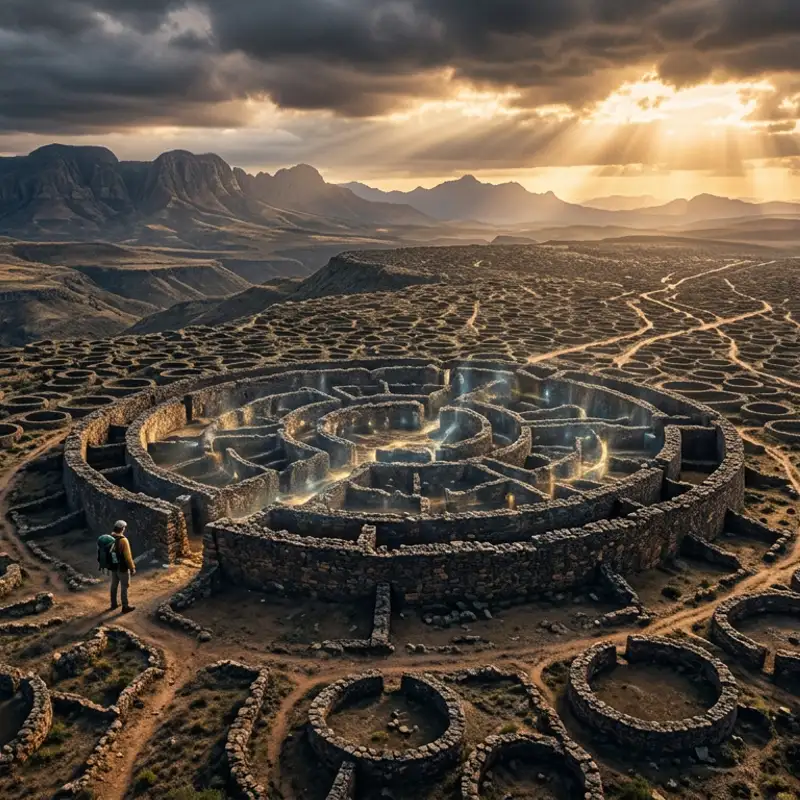
This is where he moved in 2007 and
started exploring the strange stone circles shattered around
the landscape.
And here comes one of the first astonishing
claims, the number.
By the time I finished counting yesterday, I
counted more than 10 millions of those stone
structures.
Not four and a half thousand, or twenty
thousand, or hundred thousand.
More than 10 million.
Oh my god, we just discovered a vanished
civilization nobody knows anything about.
10 million stone circles.
If that number holds true, that is the
largest concentration of ancient ruins anywhere in the
world.
For comparison, there is about 138 pyramids in
Egypt.
But what are those circles?
According to Tellinger's, the answer is neither houses
nor cattle enclosures, because there is one crucial
detail.
The key thing here is that there's no
door and entrances.
So this cannot be dwellings for people, or
cows, or animals.
Because clearly they were not built with doors
and entrances.
They are something else.
As early as 1939, archaeologists noticed the lack
of doors and entrances.
So what were they then?
Tellinger's answer is that they were gigantic energy
machines created to amplify the earth's natural frequencies.
And the key to understanding this lies in
the phenomenon of semantics, the sound's ability to
create physical patterns.
Every sound frequency has a very specific own
shape.
The stone circles are just semantic patterns representing
the shape of the sound coming out of
the ground at that specific place.
He refers to experiments where sand on a
metal plate forms a complex geometric pattern when
the plate vibrates.
In the same way, Tellinger's says, each and
every stone circles reflect the sound frequencies of
the underground, and by placing stones precisely on
these patterns, the ancient builders amplified the energy.
In the middle of this enormous network of
stone circles lies a place Tellinger calls Adam's
calendar, rediscovered in 2003 by a pilot named
Johan Heine.
This site is the oldest example of a
working Sun calendar.
It still works.
As you can see, the shadow of the
rock closest to us casts a shadow on
the calendar stone, and it moves from left
to right, from summer solstice to winter solstice.
When it reaches the right edge, it comes
back.
So you can tell every day of the
year based on the setting of the Sun.
But according to Tellinger, it's much more than
just a calendar.
It's a powerful energy machine, the most powerful
of all the ruins.
We measured a beroind 375 gigahertz, 1700 megahertz
electromagnetic field running horizontally, and another one running
vertically out of it.
We definitely have the indication of a toroidal
vortex field being generated.
He claims the sites generate a toroidal field,
a donut-shaped energy vortex, and that drones
that flew over the site consistently loses connection.
And then there's the oil traditions.
Tellinger sought out the late Shul Shaman Kridhu
Muthwa, sorry for my pronunciation, who broke down
crying when he saw photos of the site.
He said he never thought he'll see this
special place again because he was initiated there
in 1937.
He said it was known as Isulu Yiyaka
or the birthplace of the Sun, where humanity
was created by the gods to be slaves
in the gold mines.
Created by the gods to be slaves in
the gold mines.
That brings us to the next layer of
Tellinger's theory.
Gold, the yellow metal that fascinated humanity for
millennia.
But according to Tellinger's, our obsession is not
our own, it's inherent.
And I personally think here he has a
point because, you know, by the end of
the day, gold is pretty useless.
I mean, you cannot make a plow of
it, you cannot make a sword of it,
you cannot make any kind of practical application.
I know it's a lot of money worth,
but for the people at that time, it
is pretty much useless, unless for jewelry.
But back to Tellinger.
Human obsession of gold is inherited from the
gods, the gods with a small g, the
Elohim, the Anunnaki.
Here Tellinger draws on the Sumerian text and
particularly Zecharia Sitchin's controversial translations describing the
Anunnaki beings who came to earth to mine
gold.
A primitive worker shall be created.
Our command he understand.
The tools, our tools he will handle to
the Anunnaki in the Apsu reliefs shall come.
Abzu, according to Tellinger, refers to the southern
Africa, the place where the gold came from,
and he points to concrete finds.
Between 2005 and 2010, Anglo-American did a
survey.
They found thousands of these ancient arid mines.
They found 75,000 of these ancient mines.
And just for the listener, Anglo-American is
the largest mining company in the world.
So, he also tells about a remarkable story
about the Sheba gold mine near Barbotown, allegedly
one of the richest gold mines in the
world.
Here the geologist was called during the 1980s
to investigate a mysterious phenomenon.
He discovered a giant, huge underground cave, larger
than the Vatican, and these veins of gold
that were oozing out of the walls, slow,
thick, jelly-type movements of gold coming out
of the walls.
Some of these veins were empty, so whoever
was mining gold had the technology to suck
out the gold of this vein without blasting
or destroying any rocks about it.
A technology, Tellinger believes, that points to the
Anunnaki.
A central element in Tellinger worldview is the
fundamental role of sound in the creation.
He often quotes the opening words in the
Bible.
God say, let there be light.
For Tellinger, this is not a metaphor.
That is a precise description of sound-manifest
lights.
He points to the phenomenon of solo luminance,
where sound waves in water can create small
flashes of light.
When you put a sound frequency into a
body of water, after a little while, a
beautiful bubble appears filled with light.
Sound in water creates light.
He believes that the universe fundamentally consists of
sound, and that all the things from atoms
to galaxies are toroidal fields, meaning donut-shaped
energy structures.
Everything manifests as a torus.
Electrons are toruses, atoms are toruses, solar systems
are toruses, galaxies are toruses.
And here comes one of the most radical
claims, that sound can travel faster than light.
In the Middle Tennessee State University in 2005,
a bunch of Stoughton students propelled sound beyond
the speed of light.
The denser the material, the slower the speed
of light.
The converse is true for sound.
The denser the medium, the faster the speed
of sound.
So how does sound travel in indifferently dense
medium immediately fast?
He connects this to the zero point, the
infinity dense center in every toroidal field, and
argues that this explains phenomena like telepathy and
bilocation.
Over the years, Tellinger has collected hundreds of
strange stone artifacts from ruins.
Two types stand out, cone-shaped tools and
donut-shaped torus stones.
Cone-shaped tools are one of the most
ignored tools and artifacts in human history.
Once you know how to focus the sound
frequencies into a cone-shaped tool, by the
time that the frequencies leave the tip, it
moves incredibly fast.
It becomes hypersound, creating what is known as
a Caesar beam.
He points to ancient descriptions, Sumerian seals, Egyptian
relief, Mayan statues, all showing beings holding cones.
And he tells the story of Ed Lietzkalnin,
who built the Coral Castle in the Florida
with enormous coral blocks.
Two boys climb over the wall and saw
him levitating those big stones with an ice
cream cone.
That is why I call it the Ice
Cream Cone Phenomenon.
The other types of the torus stones.
Tellinger has a very special story about them.
In 2013, I packed these torus stones in
a bubble wrap, threw it in my hand
luggage at Doha International Airport.
They hauled me off the plane.
Five guys with guns, security threat in your
back.
When I come back, my partner said, when
the captain came out of the cockpit, he
says whatever was in that bag crashed the
TSA security system.
So we had a homeland security to thank
for proving our scientifically that is where we're
dealing with the ancient advanced technology.
He also shows thermal images of the torus
stones that allegedly shows a temperature difference up
to 20 degrees Celsius between the two sides
of the stone, which he interprets as evidence
that the stone generates energy.
In 2018, Tellinger's research took an unexpected turn.
During an expedition, he and his team found
what they believe are petrified body parts from
giants and from unknown creatures.
Nothing could have prepared me for the discovery
of January 2018, when my first stone circle
research team accidentally discovered the mud fossils of
giants and other creatures.
He describes how for years he walked past
strangely shaped stones without understanding what they were,
but suddenly it dawned to him.
I pick up a stone and thought, why
is this stone this weird shape?
And when the penny dropped, I said, oh
my god, it's a rib.
And then anything changed.
Since then, he collected hundreds of these fossils
in his museum.
He shows pictures of what he has identified
as a heart with visible coronary artery, confirmed
by a passing surgeon, ribs, some of them
with marks that look like knife cuts, a
jawbone 20 times larger than a human, a
claw from an unknown creature, a hoof, skin
with reptilian-like scales.
The fascinating thing is that this fossilized process
completely transmutes from horn-filled rocks.
You can hardly see the internal organs.
It just converts anything into horn-filled rocks
that rings like a bell.
He knows that many of the stone circles,
stones, are actually petrified body parts and that
they ring like a bell when struck.
Tellinger connects these finds to an ancient text
about giants.
In the book of Enochs, it clearly talks
about giants that were 3,000 eels high,
and eels is just short of a half
a meter.
So 3,000 eels makes these giants one
and a half kilometer tall, or just short
of a mile.
He also showed pictures of a giant footprint
in granite near his home.
This giant footprint is in granite.
When I first started showing this, people said
this is impossible to leave a footprint in
granite.
That's based on this, their feeble and childlike
understanding of geology.
We now switch to the gold, the Kruger
gold.
Tellinger connects to the ancient mysteries with more
recent history, particularly the Second Boer War that
was in 1899 to 1902, in which he
called a war over gold.
The British Empire sent 470,000 men to
fight about 60,000 farmers.
The most powerful empire in history fighting a
bunch of farmers on horseback.
You gotta ask yourself, why?
The answer, according to Schellinger, lies in President
Paul Kruger's mysterious gold reserve.
On June the 4th, 1900, a train filled
with gold left Pretoria.
It was a train loaded with gold, not
one carriage, estimated range from 3 tons to
3,000 tons.
The train vanished without a trace after the
town of Machadordorp.
Sorry, look in the transcript for the right
spelling, but Tellinger also asked different questions.
The question is not what happened to the
train, the question is where did Paul Kruger
get all the gold from?
The gold production in 1900 was about one
and a half ton per annum, so where
did he get dozens or maybe thousands of
tons from?
His theory is that Kruger's men digging tunnels
to hide from the British Empire stumbled upon
ancient Anunnaki tunnels filled with gold, hidden before
the Great Flood.
They probably stumbled upon the ancient Anunnaki tunnels
filled with possessed gold, where they only had
hidden the gold before the flood came and
destroyed everything.
This is what made Paul Kruger so incredibly
dangerous to the royal bloodlines.
He also mentioned the discovery of the pre
-Inca statues in the sinkhole tunnel near Charleston
in the 1970s as evidence that various ancient
sculptures were in South Africa, likely brought here
by the Anunnaki.
After all this information in the past, Schellinger
turns his gaze to the future, because what
good is all the knowledge if you don't
use it?
If we can't put this information into good
use, it's completely bloody useless.
His answer is the Ubuntu movement and one
small town can change the world, his initiative.
The idea is simple.
Find a small town of around 5,000
people who wants to participate in their own
makeover.
Identities, special skills and talents.
Everyone contribute three hours per week towards community
projects.
Reproduce at least three times as much as
we need.
One third is distributed freely to the participant.
Two thirds sold on the open market, cheaper
than any competitor because of free labor.
The goal is to create a parallel economy
that makes money obsolete.
Money will become the tool that destroys capitalism.
We use the tool to enslave us, to
free us from that slavery.
He sees this as an illusionary necessity, a
way to break free from the system that
he believes has been imposed on humanity by
the first royal bloodlines that came from heaven
with fierce weapons.
Michael Tellinger's universe is one where nothing is
what we thought.
Where sound is the primary creative force, where
giants with a mile tall once walked the
earth, where the Anunnaki might go using advanced
sound technology, and where the remains of the
civilization lies scattered across the southern Africa.
Ten million stone circles still humming with energy.
Is it science, is it fantasy, or is
it a blend?
As he said himself, the more questions we
ask, the more mysterious things become.
And if anybody ever tells you, don't research
that, you should probably be on the right
track to something.
Whenever one thinks Tellinger's conclusions, he is undoubtedly
brought attention to a remarkable archaeology landscape that
the mainstream research has largely ignored.
But let's talk about the traditional scientific view.
So how does the established science say about
Michael Tellinger's claims?
Let's take them point by point.
The circular stone structures Schellinger refers to is
well known to archaeologists.
They are typically assessed with the Balconic culture
or the early Sotho-Tswana people and dates
to between 1500 and 1800 CE, so it's
relatively recent.
They interpreted as the combination of dwellings, cattle
enclosures, and ritual sites.
Many actually has opening contrary to Schellinger's claims.
Archaeologists note that the openings are often collapsed
or filled with soil over the time, which
may explain Tellinger's observations.
If we talk about the Adam calendar, the
stone formation at Karp's Hoop, which Tellinger's calls
Adam's calendar, is according to geologist and natural
dolomite formation.
South African geologist Maurice Widjo has pointed out
that similar natural stone formations exist throughout the
region, created by erosion and geological processes.
Archaeostromers, who have visited the site, find no
convincing evidence of deliberate astronomical orientation.
The alignment tells us point to fields which
in what will be statistically expected from a
random stone placement.
Regarding the gold mines and Anunnaki, Tellinger claims
that 75,000 ancient mines and Anunnaki prisons
rest primarily on royal sources and personal interpretations
of Sumerian texts.
Sumerologist notes that Zacharias Sitchin's translation, which Schellinger
cites, are widely rejected by academic Sumerologists.
Sitchin's reading cuneiform does not follow recognized linguistic
methods.
Abzu in Sumerian mythology means the underworld or
the freshwater ocean beneath the earth, not South
Africa.
And regarding the sound and cymantics, the sound
creates visible patterns in sand.
Cymantics is a well- documented physical phenomenon.
But Tellinger's leap from where to the stone
circles being deliberate sound machines lacks scientific evidence.
He claims that sounds travels faster than light
based on a misunderstanding of the 2005 Middle
Tennessee experiment.
The experiment concerned phase velocity in a specific
medium, not breaking the speed of light barrier
in vacuum, which is a fundamental physical constant.
Sound cannot, under any circumstances, exceed the speed
of light in a vacuum.
Regarding the giant fossils, Schellinger's mud fossils are
interpreted by geologists as natural concreations.
Mineral participates can assume organic shapes through natural
processes.
This phenomenon is well known and is called
peridolia, where the brain sees tendencies.
The brain has a tendency to recognize simple
patterns in a random formation.
The large footprint in granite at Mount Pulanga
is, according to geologists, an example of different
erosions, where softer materials has eroded faster than
the surrounding material.
That vertebrate fossil transmutes into Humpfield is geological
nonsense.
Fossilizations preserve the form but does not change
the mineralogy into a completely different rock type.
Regarding the tar stones and cones, Schellinger's tar
stones are known archaeological artifacts that are called
board stones or digging stick weights.
They are found throughout Africa and is associated
with the sand people, which uses them as
a weight on digging sticks.
Tellinger's claims that they were a kind of
energy generator is not supported by any independent
measurement.
The story of the TSA security system that
were crashed is anecdotal and is not documented.
Regarding the gold, historians agree that gold was
transported out of Pretoria during the war, but
Tellinger's figures of thousands of tons lacks historical
basis.
The total gold reserve of the Transvaal Republic
were documented and far smaller.
The trained disappearance is the most possibly explained
by the gold being distributed and hidden into
smaller portions, which is a common practice during
wartime.
So the summary is that Schellinger is correct
that Southern Africa contains a rich archaeology landscape
that deserves more attention.
The scientific consensus rejects his interpretation of a
speculative and lacking methodical foundation.
His theory falls in the category of alternative
archaeology or some say pseudo-archaeology, a field
that often appeals to people fascinating with the
unknown, but does not meet the scientific standard
for evidence, possibility, and peer review.
Nevertheless, Schellinger, with his claim and his charisma
and the ability to tell a compelling story,
has built a significant following and has brought
focus to a fascinating cultural landscape that many
would otherwise not have heard of.
So if I sum this up...
So, if I sum this up, I'm
not a scientist, I work with economics.
And I'll tell you one thing, that is
that nobody builds a million stone circles without
a purpose, and especially not at the time
of the alleged construction.
If it really is true that it's only
300 to 500 years old, then there should
be remains of, should we say, the construction
record.
Somebody must know something.
One, second, that is a very large construction
from a small population that, according to my
understanding, was not there at the time.
So, bottom line here is, I need an
explanation on why so many has been built.
It's industrial, and nobody built industrial without a
purpose.
And I think that challenges us up to
something here, because would you build a stone
00:31:31,660--> 00:31:32,660
circle for enclosure of cattle?
Of course not.
You will use something else.
I mean, the local materials.
You will find, I don't know, some kind
of sticky tree or something like that, planted
in a circle, and then during the years
you will have a perfect enclosure that lions
and so on could not pass.
Things like that you will do, you will
not spend the amount of work hours required
for this construction.
That is my humble opinion.
Thank you.
Until then, thank you for listening.