Hello and welcome back.
Today is Sunday and hereby it's time for
another episode of our podcast.
Today we are going to dive into one
of the most sensational, controversial and fascinating alternative
worldviews ever put forward.
It concerns the origin of mankind, the meaning
of our civilization and what awaits us in
the future.
The man behind it is Zacharias Sitchin, a
Russian-born Israeli author who passed away in
2010 and who spent more than 40 years
of his life analysing the Sumerian clay tablets,
the Bible and the archaeological finds.
His conclusion, humanity did not emerge through a
random mutation, we were created and our creators
came from another planet, a planet that appears
in the ancient text under the name Libero.
Today, as your host, I will guide you
through Sitchin's framework of thoughts as it unfolds
in the text I have in front of
me, including his lectures and the central books
in the Earth Chronicles series.
I will read direct quotes from Sitchin so
you can hear them in his own words
or perhaps written by me.
I will do that because, I mean, he
passed away, so it's not possible to do
it the other way.
And in the end, we will turn our
gaze on what the established science has to
say.
What do archaeologists, astronomers and linguists make of
Sitchin's claims?
You will get that too, so buckle up,
grab a cup of coffee, because this is
the cosmos of Zacharias Sitchin.
Imagine standing in what is now southern Iraq
for about 6,000 years ago.
The area is primitive, hunters, gatherers, scattered settlements,
and then, as Sitchin puts it, suddenly, unexpectedly,
out of nowhere, a highly advanced civilization appears.
The Sumerians, Sitchin says in one of his
lectures.
About 6,000 years ago, an incredible civilization
appeared there.
All those who deal with it use such
words as suddenly, unexpectedly, out of nowhere, because
there is no gradual or any kind of
procedural civilization.
Suddenly, there appear cities, high-rise buildings, societal
organization, kings, priests, codes of law, literature, mathematics,
arts, music, all within a very short period.
And that is what really puzzles Sitchin.
How could humanity, after millions of years of
slow development, suddenly take a quantum leap?
He underscores it with a calculation that puts
time into perspective.
We are about 2,000 years from the
time of Jesus.
That time was about 2,000 years from
the times of Abraham.
And another 2,000 years, and that's where
this great civilization suddenly appeared.
But what did that civilization entail?
Sitchin points to three firsts.
First, the writing system, cuneiform, which made it
possible to write down laws, poetry, medical recipes,
and even a recipe for cocoa wine, which
is a chicken cooked in wine.
Second, the cylinder seal, in great, semi-precious
stones that printed a motif on wet clay
like a modern rotary press.
And third, high-rise constructions.
The Sumerians used bricks and erected temple towers,
these so-called sigarettes, up to 160 feet
high.
But the most astonishing thing, according to Sitchin,
is their astronomical use and knowledge.
He shows a cylinder seal from around 2
,000 BCE.
This seal depicts the sun, it depicts the
earth and its moon, it depicts the asteroid
belt, and behind Jupiter you see Saturn with
her rings, which we did not know anything
about until the invention of the telescope.
So how could the Sumerians have known about
phenomena that require advanced optics?
Sitchin's answer is blunt.
They were given the knowledge by someone who
came from outside.
And here we come to the core.
Sitchin's first book was titled The Twelfth Planet,
and the point is that our solar system,
according to the Sumerians, had 12 members, not
9 planets plus the sun and moon, but,
as Sumerians counted, the sun, the moon, and
10 planets.
The 10th planet, which Sitchin calls the 12th
in the Sumerian reckoning, is Nibiru.
And it is depicted on yet another cylinder
seal, the so-called VA-243, that is
now in Berlin.
Sitchin explains.
If you ask scholars what that scene depicts,
their answer, it's a mythological scene where the
gods of the early culture grant the plow
to the mankind.
But if you look at the celestial depiction,
it shows a star surrounded by planets, all
the planets we know with the correct size
and the correct order, except there is one
more planet right between Mars and Jupiter, where
the asteroid belt is now.
So how did this planet come into being?
The Sumerians, a great creation epic called the
Enuma Elish, described, according to Sitchin, a cosmic
collision billions of years ago.
I quote from his retelling.
Once, when the solar system became into coherence,
an invader from another solar system, a planet,
passed near ours, was caught by the gravitational
pull and changed course.
It moved into the opposite direction of the
other planets and reached great orbit.
Eventually, it collided with one of the original
planets, which this tech called Tiamat.
Tiamat, a female celestial body with 11 satellites,
was struck by Nibiru's moon, split into two.
One half became the asteroid belt, the hammered
bracelet, as the Bible calls it, and the
other half, along with Tiamat's largest moon, was
thrust into a new orbit that became our
planet Earth and our moon.
Sitchin points this out.
Modern science tells us that all the continents
used to be on the one side of
Earth and the other side was just a
huge cavity that was filled with water, still
called the Pacific Ocean.
If you read about the origin of the
moon, it all collaborates.
It all agrees with the Sumerian cosmology.
Nibiru itself remained into an elongated elliptical orbit,
bringing it back to our vicinity in approximately
3600 years, a divine year in the Sumerian
numbering system.
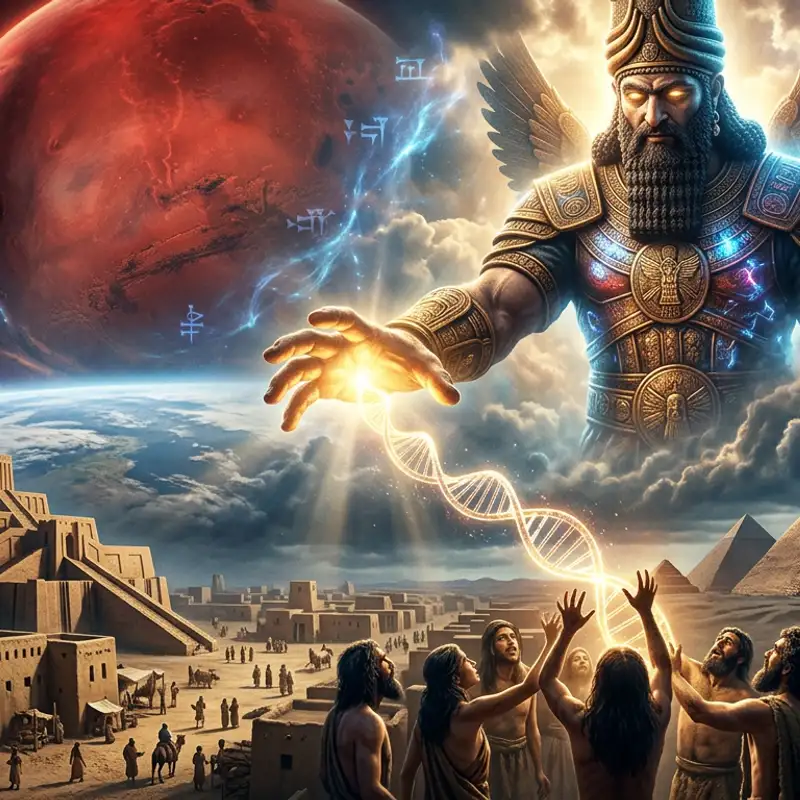
According to Sitchin, it was from Nibiru that
the Anunnaki came.
The name means something along those lines.
Those who from heaven to Earth came.
And they came with a purpose, gold.
Basically, gold.
Sitchin reads from Enki's autobiographical text.
When I approached the Earth, I saw greenish
marshes.
We splash-landed in the waters.
I commanded so-and-so to test the
water for probability.
I commanded so-and-so to build us
a kind of a shelter.
I commanded so-and-so to see if
there was edible food.
But it wasn't about sightseeing.
The Anunnaki needed gold to protect their dwindling
atmosphere in their own planet.
They needed gold particles as a shield to
protect the atmosphere on Nibiru.
First, they tried to extract gold from the
waters in the Persian Gulf, which failed.
They then turned the actual mining in South
-East Africa.
The Anunnaki workers toiled into the mines until
they, according to the Atrahitis epic, mutinated.
They said, no more.
This is not the kind of work we
can do.
We are astronauts.
We are not mine workers.
And there was a great consternation among the
leadership what to do.
The solution became mankind.
Enki, the scientist among the Anunnaki, proposed taking
an already existing creature, Homo Erectus, and upgrading
its genetic sequences.
Enki said, all we have to do is
to put our mark on it, our genetic
mark, and thereby raise that being more to
our level so it could follow our command,
understand our language, and do the work for
us.
The creation story is found in detail in
Sumerian text.
Through trial and error attempts, Enki and his
half-sister, Nihursag, mixed their genes with those
of Homo Erectus and created what they called
the perfect model, Lulu Alilu, the first human.
Sitchin quotes the goddess Triumph Cry.
She shouted, my hands have made it, and
that, ladies and gentlemen, is how we came
about.
He points to the striking parallel to the
book of Genesis, where the Elohim, in the
plural, the lofty ones, say, let us fashion
the atom in our image and after our
likeness.
Atom means earthling because he was made from
the elements of the earth and from the
essence of the god.
Sitchin quotes a Sumerian text.
The body of man was fashioned from a
mixture of god blood and the clay of
earth.
And Homo Erectus was put into work in
the mines and later in the gardens of
Eden.
According to Sitchin, the flood was not God's
punishment for the human sinfulness.
It was a predictable nature disaster triggered by
the end of an ice age when enormous
ice masses slid into the sea.
Anunnaki knew this was coming but swore to
keep it hidden from mankind except for Enki
who instructed Atrahitis, or should I say Noah,
to build an ark.
Sitchin recounts, When the storm began, the Anunnaki
took off in their shuttlecraft and remained in
earth orbit until the waters began to subside.
They saw Mankat dying below and the goddess
Nyuhasak lamented, My creatures have become like flies.
After the flood, the Anunnaki had to rebuild
their infrastructure.
They could no longer use the mud-covered
Mesopotamia, so they laid out a new landing
corridor with four central spaces-related sites.
The twin peaks of the Ararat Mountains as
a marker, the new mission control center in
Jerusalem, and a spade port on the Sinai
Pendula, and the artificial twin mountains, or should
I say the Pyramids of Giza.
Sitchin emphasized, Jerusalem was chosen as mission control
because it lay equidistantly from the other points,
exactly as Nippur has done before the flood.
So why is Jerusalem sacred?
For the Muslims, because Muhammad ascended to heaven
from there.
For the Christians, because Jesus ministered and died
there.
For the Jews, because the temple stood there.
But Sitchin asked, why precisely there?
There's no river, there's no resources, there's no
strategic trade routes.
The locations make no sense, unless you know
the Anunnaki landing pattern.
He reveals, The Temple Mount is an artificial
platform built by colossal stone blocks weighing up
to 600 tons, much larger than the 25
tons blocks in the Great Pyramid.
The western wall was excavated, a trillion tons
was found, three gigantic stones side by side,
exactly as in Baalbek in Lebanon.
Baalbek, according to Sitchin, was the actual landing
platform for the spacecraft.
He mentioned the Epic of Gilgamesh, where the
hero witnesses a rocket launch.
The heavens shrieked, the earth boomed, through daylight
was drawing, darkness came, lightning flashed, a flame
shot up, the clouds swelled, it rained death.
Then the glow vanished, the fire went out,
and all that had fallen was turned into
ashes.
A Phoenician coin from that era even depicted
the rocket on a piteous hill.
The Anunnaki were, however, not an anonymous family.
Clan feuds between Enlil and Enki's lineages escalated
into war.
Sitchin describes the Pyramid War, in which the
two sides fought for control over the landing
facilities.
Eventually, around 2024 BCE, they used nuclear weapons.
In a text called the Era Epic, it
is described how nuclear weapons were launched against
the spaceport in C9.
The crater can still be seen from space,
and the wind carried the radioactive cloud towards
Sumer.
The city stood, but all living things were
dead.
That was the end of the Sumerian civilization.
It was after this Sitchin believed that the
story of Sodoma and Gomorrah arose as an
echo of this catastrophe.
In his later years, Sitchin worked with the
biblical prophecies about the end of days.
He distinguished between the Day of the Lord,
which is the physical return of Nibiru, and
the end of days, which is an era
ending when the Anunnaki returns.
He explains that as Nibiru approaches, its symbol
shifts from the wing dish to the cross,
which is why the cross symbol begins to
appear in the Mesopotamia, in Egypt and Assyria
around 1000 BCE.
Each time that reappearance of Nibiru was expected,
the depiction, the symbol for Nibiru changed from
the wing dish to the cross.
This is not a new sign invented at
the time of Jesus.
That is a very ancient Sumerian sign.
The last time Nibiru was near Earth, as
Sitchin calculated, was in 556 BCE, when an
unexpected solar eclipse occurred.
With an orbital period of roughly 3600 years,
it makes no sense that the world should
end in 2012, as some Maya calculator has
claimed.
2012 does not work.
The only thing that is certain about 2012
is that there is another presidential election.
Nibiru does not come in 2012.
It may come within our century, still within
the age of the Pisces.
Sitchin refers to Sir Isaac Newton's handwritten calculations
of the Daniel prophecies, where the number 2160
occurs.
That is a zodiac age of 2160 years,
and it is precisely at Armageddon.
A church that was discovered in the early
2000s, with a mosaic floor depicting Pisces.
I believe these things are omen.
What will happen, I don't know.
But the biblical prophecies say, at a time
of the tribulience, will come before the god
returns and set things right.
A fascinating side of the aspect of the
attached text are the so-called mixed creatures.
Perhaps you know these things.
A human head on a lion body.
And it's not just symbolic.
According to Sitchin and the related author Erik
van Dyneken, who lectures, this is also in
my material here.
The god created mixed creatures through genetic manipulation.
Not as a fantasy, but as a functional
being for different planets.
A lion's strength combined with a crocodile's heat
-resistant skin are ideal for a hot planet.
In Saqqara in Egypt, archaeologist Auguste Mariette discovered
gigantic sarcophagi containing bones from different animals, smashed
and buried into bitumen.
Sitchin's interpretation is that the god is preventing
these manipulated hybrids from ever resurrecting in the
afterlife.
This underscores his point.
The old gods were genetic engineers using DNA
technology long before we have any conceptual knowledge
of it.
Those were the words of Sitchin.
But how does the established science take this?
I will try to do that in this
final section, where I will try to tell
what they think of it.
We will start with astronomy and planetary science.
Astronomers completely reject the existence of Nibiru on
a 3,600-year orbit that will bring
it into the inner solar system.
Such an orbit would be unstable and would
either reject the planet from the system or
cause it to collide.
The asteroid belt is, according to modern science,
not debris from an exploded planet, but material
that was never created into a planet due
to Jupiter's gravity.
The Sumerians' astronomical knowledge, while it is impressive,
has no evidence of knowledge of Uranus, Neptune,
and Pluto, planets that require telescopes.
The cylinder seal called VA-243, which Sitchin
uses as his main evidence, is dismissed by
the astrologist with a simple rendering of stars,
not our solar system.
And the number of dots does not even
match the elliptical configuration.
If we look into the history and the
archaeology, then Sumerologists like Samuel Cramer and others
point out that Sitchin grossly mistranslates and plucks
text out of context.
For instance, the word Sheem is not a
rocket ship, but means name of Reno.
The Sigurads were temples, not spaceports.
Baalbek's giant stones remain an engineering puzzle.
But there is no genuine indication of pre
-Roman space family technology, and the pyramids were,
in all its probability, built by the Egyptians
in the Old Kingdom, dated precisely in which
archaeological and historical methods.
In terms of genetics and biology, the idea
that the humans were created through genetic manipulation
300,000 years ago is contradicted by fossil
finds and DNA sequence, which shows a gradual
evolution over millions of years.
Our genome shares 98-99% with chimpanzees,
but the differences are fully compatible with natural
selections and mutation.
There is no crossbreed with extraterrestrials.
And if we look at the biblical, then
Sitchin's reading of the Bible according to theologians
is a misinterpretation.
Nifilin, can, means the fallen ones, and refers
in context to violent men, not to astronauts.
The Elohim plural form is a linguistic, myaesthetic
plural, not a group of space gods.
Sitchin's imposed a modern space age upon ancient
mythology.
So, in summary, Sitchin's hypothesis is considered by,
should we say, the scientific consensus as pseudoscience.
Imaginative, but lack of evidence.
Nevertheless, one cannot deny that it raises questions
about humanity's fate.
So, the conclusion, yeah.
The conclusion is that by the end of
the day, you have to conclude yourself in
which you want to believe.
Zachary Sitchin, or should we say the established
science, I'm personally not so sure about it.
I prefer to trust in the scientific community.
However, I have a big problem because the
alleged methods should also be able to create
these kind of things.
And one of the key things that the
modern science is not able to, is precision.
Even that you are able to do this
manufacturing of, say, pyramids or the sacrifice in
Saqqara and so on, you still need to
achieve the precision.
And nobody ever, to my knowledge, has found
the measurement things that are required to do
so.
For me, it's not a discussion if you
are using an angel grinder as a power
tool or you are using a pounding stone
and copper chisel.
That's not the key thing.
The key thing is that how do we
apply it with that precision that is demonstrated.
And here, the modern science is lacking, seriously,
to put it bluntly.
So for me, it's two different explanations.
You can pick the one you like, but
facts is that the alleged construction measures proposed
by the modern science does not work.
You can do it yourself.
I mean, even with an angel grinder, you
cannot apply a precision of a thousandth of
a millimeter.
But that is actually what they are doing,
some of the statues and other constructions.
Anyway, have a nice day and see you
again next week.
♪♪♪