Hello, it's Sunday and I'ts time for another podcast episode.
But before we get started, just a quick disclaimer.
I am probably going to pronounce quite a few names creatively, especially if we move beyond
English.
I promise I will try but feel free to use your imagination and forgive me in advance.
The correct spellings and pronunciations is of course in the transcript if you want the
accurate version.
This channel is a hobby project driven by curiosity and a general interest in the topics
I explore.
I use my own voice and my own words to create independent analysis and commentary based
on research from various sources, including publicly available videos and materials on
YouTube.
The purpose is not to copy other creators' content, but to discuss, analyze and provide
perspective on topics on my own way.
So today we are going to revisit Amanda May, Philippe Bondy and the lost civilization between
the Giza Plateau and the reason is simple, that another Sphinx is apparently there.
So for thousands of years, the pyramids on the Giza Plateau has stared over the desert
like silent witnesses to a distant past.
The official history books tells us that they were built around 4500 years ago by the
pharaohs Khufu, Khafre and Mikur, tombs raised with the sweat and ingenuity of massive stonecutters.
But what if the story is nothing but a myth?
What if the pyramids is far older, built by a previously unknown civilization and conceal
a message encoded in mathematics, geometry and the stars?
Today we will meet two central figures behind the Khafre research project.
The Italian-Egyptialist Amanda May, with his theory of Zetepi and the original alignment
of the Giza Plateau, has challenged the entire establishment's history and the radar engineer
Filippo Bondy, the man behind the groundbreaking Doppler tomography that has revealed enormous
underground structures and now, according to him, with 100% certainty, a completely different
Sphinx.
We trace the project from those first fumbling scans dismissed as noise to the concrete plans
to clean the shafts and to excavate the second Sphinx.
We hear the researchers' own words and finally we turn our gaze towards traditional
Egyptology and ask, what does the establishment actually make of this?
Welcome to a journey into the world of the Khafre project.
First let's meet the man, who is Amanda May.
Amanda May described himself as a journalist, an Egyptologist and an author, but not the
kind that you will meet in a university's lecture halls.
He often stressed that he is specifically not an academic Egyptologist, as he put it.
I am not an archaeologist, luckily, because then I would be standing here telling you
that the pyramids are tombs, that the king lists are historical, and that the theory
in papyrus has no relevance.
Instead, I had the mental freedom to approach the subject from a different point of view.
His passion for the ancient Egypt was ignited in childhood, as he recounted in several interviews.
When I was in elementary school, I saw a photo of the great pyramids of Giza for the first
time.
It sparked a love that never faded.
At 14, I read my first book of the ancient Egypt by Alan Gardner, and I never put down
the subject since.
May has published a trilogy of books, the first one, 36,400, The Secrets of the Gods,
The Pyramids and the Secrets of the 137, and lastly, The Key of Time.
In them, he unfolds his theory about the pyramids that were built around 36,400 BCE, nearly
38,000 years older than we are taught in school.
He relocated to Cairo to be closer to the research, and is known for a fearless voice
challenging the power structures behind the official version of the history.
Since September 2022, May has been a part of the CAFRA Research Project, an interdisciplinary
group founded by the chemistry professor Malanka and the radar engineer Felipe Bondi.
The project combines experimental archaeology with advanced satellite radar technology to
scan both the interiors of the pyramids and the depth beneath the Giza Plateau.
May is the project's historian and archaeology consultant.
Before we dive into the discoveries, we need to meet the man whose brilliant technique made
it all possible, Felipe Bondi, Chilean communications engineer and one of the world's leading experts
in synthetic aperture radar.
In a conversation in the Cosmic Text podcast in April 2025, Bondi explained how his technique
is working.
It didn't begin with the pyramid at all, it was born from a strategy.
In 2015-2016, I developed a method to measure micro-vibrations from the Earth's surface
using synthetic aperture radar.
It was originally intended to monitor large infrastructures, especially bridges.
At that time, the Miranda Bridge in Guinea collapsed during a storm and 43 people died.
I wanted to make sure nothing like this will ever happen again.
The method could automatically detect micro-cracks, cracks that are normally harmless but can grow
and lead to disaster.
So, the technique was conceived as a humanitarian tool, but then Bondi met with Professor Corrado
Malanca, and the two of them started thinking, if we can measure vibrations on bridges,
can we measure vibrations in the pyramids?
We decided in 2019 to point the technique at the pyramid at Cofru, and it worked.
What follows, however, was not a smooth triumph.
When the first scans at the pyramids at Cofru showed strange structures extending deep underground,
Biondi thought that it was a glitch.
Malanca asked me, Philippe, what is that?
And I said, I don't know, probably just noise.
The first day, the first week, the first month, I said, noise.
But we changed radar angles.
We used different satellite images.
We changed everything, and the same structures keep appearing.
After two months, we had to admit, it was no noise, noise is random.
This repeats with precision every time.
That was Biondi's personal eureka moment.
And what he and his team had found was nothing less than eight enormous cylindrical shafts
beneath the pyramids at Cofru, along with two gigantic cube chambers about 80 meters
on a side, and below them, even deeper structures down to 1.2 kilometers beneath the surface.
That is around 0.8 mile, if I calculate correctly in my head.
So how can a radar locate in the outer space, 600 kilometers out of space,
see several kilometers into the ground,
when every physicist knows that electromagnetic waves can't penetrate Earth?
The answer lies in sound, or more precisely, vibration.
Biondi explained the principle in this way.
The radar transmits electromagnetic pulses toward the Earth's surface.
When hit by a small portion, the energy will be converted into heat and sound.
That is what we call phonons, mechanical vibrations.
These vibrations travel down into the surface, reflect off voids and dense structures,
and return to the surface, where they can be registered as tiny movements
on the order of a hundredth of a millimeter.
By analyzing these movements, pixel by pixel, we can reconstruct a 3D image of the subsurface.
It is like a record player reading the grooves on a vinyl record just from space.
It is this combination of electromagnetic and acoustic data that makes it possible.
Biondi called it a space sonar, and he emphasized that the method has been validated step by step,
first in a lab with a pizza doughnut ball, a computer and a vibration table,
as he says with a smile in one of the interviews,
then on a mountain tunnels in Nevada, and in Italy's Gran Sasso, and the Musel Dam in Iraq.
On a highway bridge, and finally on the Osiris shaft at Giza.
Those known dimensions match the tomography exactly.
Only then did the team tackle with the unknown structures beneath the pyramids.
Amanda May's fundamental claim is that the pyramids were not built by the pharaohs of the 4th dynasty.
He presents a long list of arguments.
He says first, no mummies, no graves, no hieroglyphs.
He points out that not a single mummy has ever been found in any of the three great pyramids.
When explorers broke into the chambers in the 19th century, they were utterly empty.
Even traces of grave robbers, pot shards, smashed objects are completely missing, as May sardonically says.
It seems that the thieves also swept the floor before they left.
Add to that the total absence of a hieroglyph on the walls inside the pyramids.
In every other Egyptian tomb, from the old kingdom to the new,
the walls are decorated with prayers, spells, and the king's name.
But inside the pyramid, nothing.
Academics claim that during the old kingdom, it was not customary to decorate burial chambers.
But May points out that the tombs all the way back to the 2nd dynasty have no inscriptions.
Second, he says that the tool could never have built the pyramids.
The tools that the Egyptologists used are displayed in museums.
That is, to put it bluntly, copper scissors, wooden hammers, stone wedges.
May often holds a picture of these primitive implements
and compares them with a 70-ton granite block in the king's chamber.
They want us to believe that they got granite blocks out of the quarry wall
at Aswan, 900 kilometers from Giza,
by pounding the wooden wedges into the cracks and pouring water on them
so the wood would expand and split the stone.
Try picturing moving a 70-ton block across the desert after that.
Then there is the Carthus forgery.
One of the few proofs that Carthus built the Great Pyramid
is the Carthus bearing his name
that the English colonel Howard Wise claimed to have found in 1837
in one of the most revealing chambers above the king's chamber.
May cites the widespread suspicion.
Every independent researcher who has seen the Carthus
says that the inscription is incorrect.
It contains spelling errors a genuine scribe would never have made.
The most suspicious thing is that it was found in a chamber nobody has visited before
just when Wise desperately needed to justify his costly expedition.
The authorities still refuse let independent researchers examine the Carthus
and for me, that is the final proof of the forgery.
Then there is the Diary of Mir and the Horizon of Corfu.
In 2013, a collection of papyrus was found at the Wadi Al-Jar
including the Diary of the Mir, a technical document
which is an official note, the transport of limestone blocks
from the Tura Gorges to Giza.
Egyptologists interpret this as evidence that the Great Pyramid
was under construction at Corfu in his 27th regal year
because the site is called Akhid Kofru, the Horizon of Kofru
and they think Akhid means pyramid.
May flatly reject this.
Akhid means horizon, not pyramid.
It's a geographic location.
If Mir, who is writing a technical report, wanted to refer to a building
he would use the word Mir, the Egyptian word for pyramid
or pyrimath, which means the house that rises up
but those words don't appear anywhere in the text.
Instead he uses a hieroglyph with two hills and a sun disk between them.
Exactly the view you will get if you stand at the Sphinx
and see the sun settling between the pyramids of Kofru and Kofu.
Then there is the water erosion on the pyramid blocks.
On the northern face of the Great Pyramid there are a few limestone blocks
that could be traces of severe water erosion
while the surrounding blocks are unaffected, may say.
These blocks were exposed to heavy rain and flooding
but probably long before the pyramid was built
the erosion must have occurred before the desertification
of around 9000 BCE.
Another hint that the moment is far older than the dynamic period.
If the pyramids are older than the pharaohs, when were they built and by whom?
Here we reach to the core of Amanda May's theory, said Tebbe for the first time.
The age of the gods and the demigods
and an astronomical alignment that places their construction
precisely at the year 36,400 BCE.
In 1993 Robert Bival published his famous Orion Correlation theory
The three pyramids in the mirror of the stars on the Orion belt
and the Sphinx is directed toward the constellation Leo at the spring equinox.
Bival dated this to 10,500 BCE, the most recent astrological age of Leo.
May acknowledged Bival's genius but believes he made some mistakes.
First, the smallest pyramid, Menkua,
corresponds with the smallest bell star, Mintaka,
which Bival's time frame stood at the meridian
while the large Alnitak would be linked to the Khufu
that was shifted to the southeast.
May says,
If the pyramid builders were so precise in anything else
they would never made such an error.
The Great Pyramid would correspond to Alnitak, the great star
and it would stand at the meridian.
Second, Bival's sky map Sirius, the brightest star
and scarce to the goddess Isis,
is below the horizon and invisible from Giza.
May finds this unlikely that the builders would omit Isis.
36,400 is the right time.
May moved the celestial clock back to the previous pre-decisional circle
around 36,400 BCE.
Here everything fells in place.
Alnitak stands exactly on the meridian above the Great Pyramid.
The entire Orion constellation tilts precisely the same way as the pyramids.
The thing still faces Leo's head
and most importantly Sirius is now risen above the horizon
and is visible to the southeast.
May also discovered that the previous overlooked structure
a so-called mastaba of green concaves
matches Sirius perfectly.
The mastaba sits on a cave rich southeast of the pyramids.
Its lower part is cut into the rocks
in a spiral shape remnant of the Sirius orbit.
And the angular position of the mastaba
matches Sirius' azimuth at 36,400 BCE precisely.
At 67.39 degrees relatively to east
versus the star is 67.58 degrees.
Armistice dimensions on the lower part in the royal cubits
and compared with the Sirius physical parameters
converted via universal constants phi and phi.
The results were striking.
The builders proportionally constructed the mastaba
so that the mirrors of the star dimension
Then there is the temple and the planets.
East of the things are two temples
the things temple and the valley temple
as well as the foundation of a third.
In the sky map of 36,400 BCE
the planets Mercury and Jupiter
stands close to the star Regulus in Leo.
The temples dimension match the planets physical data
with the help of metaphysical constants.
The third temple rotated relative to the others
forms an ellipse with the things
that exactly depicts an epic plane at that time.
The builders signed the entire plateau
from east to west as a gigantic astronomical clock.
Then there is the water table
and the constellation of Aquarius.
On the west on the opposite end of the plateau
lies a tomb called NC2 or the tomb of the birth.
It contains natural and artificial passages
that stretch towards the underworld
with traces of salt water and sodium crystals on the wall.
In the 1920s German and American geologists
found evidence of an ancient river the Urnil
that flow from the Mediterranean
through the Libyan desert and passed close to Giza.
The sky map shows the constellation Aquarius
standing precisely in the west
almost below the horizon opposite Leo
and its counterparts on the ground
are the tomb of the birth.
May concludes.
As above so below.
The entire constellation sphere was reproduced
at Giza Plateau 36,400 GbE
to the date of Set-Tabi.
Then there is the hidden knowledge
in the numbers 137, 4, 4, 432
and the four prime numbers.
For me these numbers are the key
to understanding the pyramid methods.
By factoring the pyramids' dimensions
May found that they can be derived
from the first four prime numbers
which is 3, 5, 7 and 11.
11 is the base constant for all three pyramids
while the height varies.
If pyramid structures were built around
the first prime numbers
the builders left a message that can be read
everywhere in the universe
because prime numbers are the same everywhere.
In the Pyramid of Khafre
the factor analysis yielded the number 137
the fine structure constant in physics
which links the strength
of electromagnetism, quantum mechanics
and relative theory.
137 is the magic number in the universe
and that was encoded in the pyramid.
137 also has an egyptologic meaning.
The entrance to the divine house of life
associated with the god Toth
May and the Khafre team
interpreted as a direct invitation
to investigate the pyramids
of the Khafre more closely.
When applying his mathematical model
to the valley temple
May found that the number 432
well known vibration frequency
that many historic tradition
is associated with the fundamental tone of the universe.
One evening while playing
with the lines on a satellite photo
May draw some lines from the bases of the pyramids
out towards the queen's pyramids.
The pattern resembled cuneiform
he found that each pyramid
corresponded to a letter combination
that is from the word Gal-Sutoi
Gal means great
Su means wise man
and Toi is Toth's name
in the egyptian book of the death.
The wise man Toth
I believe that is Toth
and all the civilization he represent
signed by the Giza plateau
with this hidden text.
Amanda May reject the idea of the egyptians
that they are religious fantasy.
In chapter 15 in the book of the death
that describes a terrible war
between Horus and Seth
a battle over Heriopolis
driven by a fight that is called the axis of Horus
May notes that the egyptian word
can also mean shaft or pillar
Imagine a war so brutal
that is about to conquer something underground
that sounds absurd
if they were just obelisk
but if they were gigantic cylinders
we now see beneath the pyramids of the Khafre
it suddenly makes sense
In the text Seth followers are called Sibau
normally described of being with a dark head
May linked the word
to the baboon species
Papua Sinusalos
whose schools
are bearing striking similarities
to the one of a Neanderthal
Neanderthals were extinct around
40,000 years ago
right around the time of the battle
is said to have taken place
I believe Sibau were the Neanderthals
whom Seth had an ally with
The myth is a distorted historical account
of a species war
May underscores that according to the book of the death
it is not the first time of a rises
it begins with the night rises
transfer his powers to his son Horus
that is the age of the demigods
perhaps the Khafre project's most sensational claim
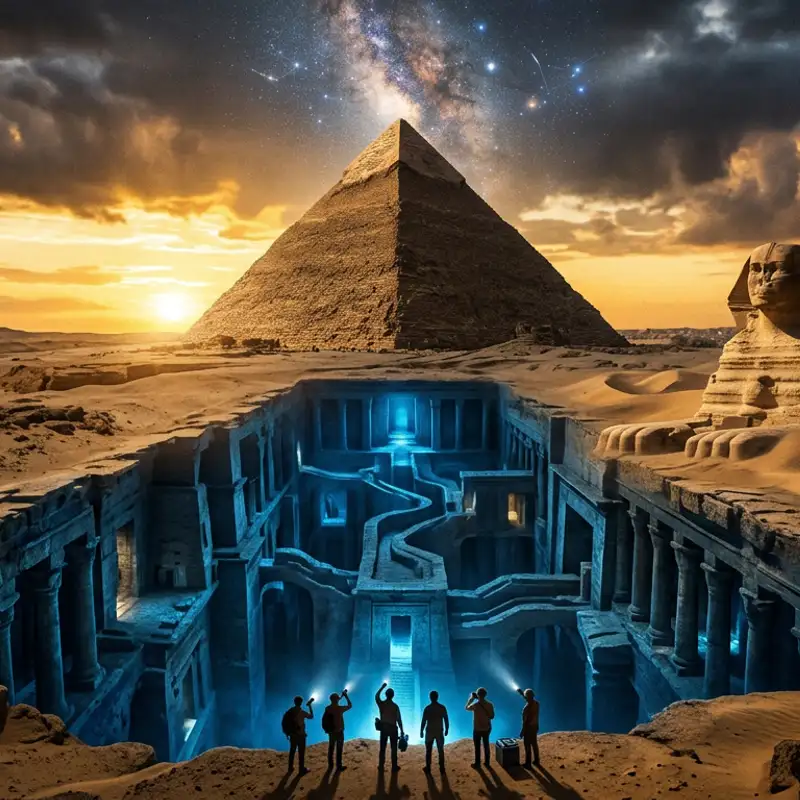
is that beneath Giza
lies an entire network of tunnels and chambers
the city of Amniti
mentioned in the myth
May references earlier discoveries
by Selim Hassan who exposed the underground
passage in the 1930s
and to Hakim Rahman
whose son reportedly got lost in the tunnels
and emerged 40 km away in Saqqara
Using the Beyond the Protocol
the team has now identified hundreds of shafts
in the plateau, many were blocked by rubble
One particular shaft in the northeast corner
between the Sphinx and the pyramids appears to be unblocked
and may provide a direct access to the network
May says
It is just a matter of cleaning out that shaft
and we can go down there and see Amniti
with our own eyes
And now we come to the discovery that has sent shockwaves
through the entire alternative research community
and which, according to Filippo Bondi
is so certain that he puts the probability
to 100%
For decades, researchers like Robert Vival
have speculated around if there might be
a second Sphinx at the Gizel Plateau
Partly because the tomb of Tutmus III
shows two Sphinxes
and because Egyptian dualism
seems to demand a counterpart
but no one has found traces of it until now
Bondi says
he was contacted by Italian researcher
Damiano Pierce
who believes that a particular low mouth
west of the pyramids might hide something
The mouth is about 15 m high
but according to Bondi
80% of it consists of debris
that archaeologists have dumped there since the 1980s
We did the first scans
Beneath the mouth we found 3 shafts
that match the shaft that we have already measured
under the first Sphinx
But it still causes
on Matt Bell's podcast
about 80% probability
But then something changed
The team keep refining the images
After the podcast
we got more computing power
improved the software
processed new images
and suddenly we could see it
a head, a body, legs
we could see everything detailed
like the tools on the path
I went from 80% to 100% certainty
there is a second Sphinx under that mouth
Most strikingly is that
according to Bondi
the head of the second Sphinx does not resemble the first
The head is different
the legs are intact
on the first Sphinx they were reconstructed
Here we can see them as they originally were
And to those skeptics
who have shown aerial photos from 1915
with no mouth
and claim that therefore there cannot be a Sphinx
Bondi responds bluntly
The mud and the Sphinx are not connected
The mud is a rubble dumped on the top later
The Sphinx lies underneath
The discovery prompts Bondi to reflect on his life works
My goal isn't to gain anything from myself
I have my life, my work, my family
I'm doing this for humanity
so we better can understand our audience for free
On the 21st of June
just a few weeks from now
the CAFRA team will gather in Bologna
in Italy for a conference
that looks to be one of the most pivotal events
in the alternative archaeology
They will present the final results
of all Doppler tomographies at the Giza Plateau
The final shape of everything
The audience will see 3D visualizations
on both the known momentums
and the underground structures
after the details of the second Sphinx will be laid out
But Bologna is more than a presentation
It will launch a physical excavation
During the conference
we will submit a project proposal to the Egyptian authorities
We will propose cleaning out the blocked shaft
between the first Sphinx and the pyramids of CAFRA
so we can gain access to the underground network
And then we will apply
for permission to excavate the second Sphinx
to physically dig it
so the whole world can see it
The project is no longer just a private effort
Bjarne mentions that the team
collaborating with the University at Ferrer
and that Italy's National Institute for Experimental Geophysics
and Oceanography
will participate in site measurements
seismic reflections
ground penetrating radar
and electrical tomography
to validate the Doppler technique
and to confirm the findings
We have three independent measurement techniques
that confirm each other
Once that's done
we can finally publish our peer-reviewed papers
on everything we found
Amanda May and Filippo Bondi
have not gone unnoticed
Reactions have ranged from enthusiasm
to outright personal attacks
French media has been particularly critical
which may explain that nothing
that France has billions invested
in the ScanPyramids project
which uses moon particles
a technology now in risk of being overtaken
We have Sahih Havas
Egypt's former Minister for Antiquities
cancelled his appearance
in a conference in Dubai
when he heard that May and Bondi would also be there
Meanwhile, podcast host Matt Bell
gave Bondi's technique
1% chance of being correct
Bondi responded calmly
I respect him
he invited me into his podcast
and I answered all his questions
but why didn't he say it directly to me
why did he have to wait until the next day
on Twitter
Anyway, I'm still here
I have nothing to hide
Amanda May faced threats in Cairo
He experienced the local mafia figures
warning him not to leave his house
In the spring of 2025
he formally left the CAFRA project
primarily because of new research projects
in Latin America and the Pacific were calling
Both he and Malanka
stressed that it was a mutual claim decision
and the collaboration continues in another form
Okay
Then let's finally turn our gaze
towards the mainstream Egyptology
and hear what they respond to these alternative theories
As usual, I have them in groups
The first one will be
that the pyramids are tombs
Egyptology points out that
on the time of the three great pyramids
a part of an architectural evolution
from the older Mastaba tombs
and that sacrifice has been found
in them all right empty
The absence of mummy is due to
grave robbing in later pyramids
texts confirm the functions as tombs
They also insist that the tools were sufficient
Granite can be cut using sand and mortar
Remains of ramps have been found
and experimental archaeology has shown
it was technology feasible
with the means at the time
The cartouches are genuine
Most Egyptologists consider wise cartouches authentic
The spelling errors can be explained
with the fact that the workers were not professional scribes
The Diary of Nemea confirms the date
Agme Kufu may indeed be
the name of the Great Pyramid
a Willis Dabbs metaphor
The Orion correlation is coincidental
The angels don't match perfectly
and the shape of the correlation
has changed over time
The thing's erosion can be explained
by a mechanism other than rainwater
There is no archaeological trace of an older civilization
Radiocarbon dating of mortar
from the Great Pyramid
yields a year around 2600 BCE
But if Biondi and May are right
if the second thing is unearthed
if the underground shafts are opened
and the three independent measurement techniques
confirms the findings
then Egyptology will face the greatest paradigm shift ever
as Biondi says
The question is
Who are we? We don't know
The answer could be that we were
dig there, find the second things
and it will give us the answers
Thank you for listening
If you are still there, please consider like and subscribe
and if you would like to follow the CAFRA project further
you can find updates on the project's Facebook page
And
if you have the chance
perhaps consider go to Bologna on June the 21st
there may still be tickets left
meet the researchers, see the image
and see where the history itself may be rewritten
See you next week