Beverly Hills, September 9th, 2002.
A 72-year-old man has been lured
into a hotel lobby on Rodeo Drive.
He thinks he's about to be filmed for
a Japanese children's TV program about space.
He isn't.
A younger man steps into his path holding
a Bible, with a camera crew right behind him.
He demands the older man swear on the
Bible that he actually walked on the Moon.
The older man tries to walk away.
The man with the Bible follows him, grabs
onto him, and calls him "a coward, a
liar, and a thief."
The older man is Buzz Aldrin.
He is the second person in human history
to set foot on a celestial body other
than Earth, July 20th, 1969.
About 20 minutes after Neil Armstrong. The man
with the Bible is Bart Sibrel, a filmmaker
and one of the most prominent voices behind
the theory that the United States never actually
went to the Moon.
Aldrin, 72 years old at the time, ended
up punching him in the jaw.
The Beverly Hills police looked into it and
no charges were ever filed.
The district attorney's office concluded that Sibrel provoked
the incident.
That image, a 72-year-old moonwalker who
finally can't take it anymore and threw a
punch, has become one of the most-shared
clips in the history of the conspiracy theory.
For some, it's proof of a guilty conscience finally
cracking.
For others, it's simply an old man who's tired
of being called a systematic traitor to his
country in front of a camera he never
agreed to stand in front of.
And that is what this episode is about.
Not settling who is right, but understanding why
so many people, in so many countries, in
so many languages, still, after more than half
a century, believe that one of the best
documented technological moments in history was a set.
You'd think
moon-landing skepticism was a relic of the
1970s, slowly dying off, along with the last
analog TV sets. It isn't.
In late October 2025, actress and reality star
Kim Kardashian publicly said she didn't believe
that the U.S. landed on the Moon.
She was referencing, incorrectly, as it turns out,
a Buzz Aldrin quote taken out of context
from a 2015 interview.
NASA's acting administrator responded publicly within days,
and British physicists from the Institute of Physics
stated that every single argument that NASA faked
the landings has been debunked.
And it's not an isolated case.
A large share of the Russian population, by
some polls, up to two-thirds, doesn't believe
Americans went to the Moon.
That is not a small, fringe segment.
That's a majority in one of the world's
most spacefaring nations.
Why does this particular theory hold on so well,
when so many other conspiracy theories from the same
era, UFO bases under Antarctica, flat-earth arguments
about NASA's logo, remain fringe phenomena?
Part of the answer is how perfectly the
Apollo program fits our deepest instinctive suspicions:
a government that lies during wartime, a science too
complex for ordinary people to check for themselves,
and a set of photographs that, honestly,
look a little too perfect for a trip
to another world.
That's the suspicion that we are going to
dig into today, not with mockery, but with
source criticism.
Let's start with what we actually knew before
anyone started doubting it.
The Apollo program was launched by John F.
Kennedy in 1961, as a direct response to
the Soviet Union's early lead in the space
race.
Sputnik in 1957, Yuri Gagarin as the first
human in space in 1961.
Kennedy's promise to put a man on the
Moon "before this decade is
out" was as much a Cold War political
maneuver as it was a scientific project.
The road there wasn't without tragedy.
On January 27, 1967, a fire broke
out in the command module during a ground
test of Apollo 1.
Astronauts Gus Grissom, Ed White, and Roger Chaffee
died within seconds.
The cabin was pressurized with pure oxygen and
a spark from faulty wiring was all
it took.
NASA's own investigation board found concrete technical failures:
flammable material in the cabin, a hatch that
couldn't be opened fast enough, and a defective
electrical installation.
It was a scandal that led to a
complete redesign of the spacecraft.
Two and a half years later, on July
16, 1969, the Saturn V rocket, still one
of the most powerful rocket humanity has ever
built and successfully flown, lifted off from
Cape Kennedy with Neil Armstrong, Buzz Aldrin, and
Michael Collins on board.
Four days later, on July 20, the lunar
module "Eagle" touched down in the Sea of
Tranquility.
Armstrong stepped onto the surface at 02:56
UTC on July 21 and spoke the now
famous words: "That's one small step for man,
one giant leap for mankind."
Five more crewed landings followed, Apollo 12
to 17, with the exception of the ill
-fated Apollo 13 mission, which never landed but
returned home safely after an explosion in the service
module.
In total, the astronauts brought back 382 kilograms of
lunar rock and soil.
That's the established narrative.
It's documented across thousands of NASA archives, independently
confirmed by physicists around the world, and,
as we'll see later in this episode,
by data from spacecraft built by four other
nations besides the United States.
Skepticism about Apollo didn't start as a
grassroots movement.
It started with one man and a self
-published pamphlet.
Bill Kaysing worked as a technical writer at
Rocketdyne, the company that built the F-1
engines for the Saturn V rocket, from 1956
to 1963.
In 1976, he published the book "We Never
Went to the Moon: America's Thirty Billion Dollar
Swindle."
Its central claim was that he had seen
an internal study calculating the probability of a
successful crewed moon landing at 0.0017 percent. That
number has been repeated for decades, in nearly
every source I reviewed for this episode, from
French to Spanish to Russian productions, but there
is a problem.
No such study has ever been found by
any researcher, anywhere.
Kaysing left Rocketdyne before Apollo's technical design was
even finished, and he had no engineering background.
He was a writer, not an engineer.
NASA's own internal calculations from the same period
showed, if anything, roughly an 87 percent
probability of at least one successful moon landing
before the end of the 1960s.
Kaysing's book laid the groundwork.
In 2001, Fox aired the widely watched special,
"Conspiracy Theory: Did We Land on the Moon?" which was
dubbed and rebroadcast in countless countries, including
the Portuguese and Spanish versions I reviewed
in this research material for the episode.
It's worth noting that several of the "independent"
international documentaries I analyzed are, in fact, translations
from the same 2001 American Fox program.
Not independent investigations, but the same source retold
in multiple languages.
This is where the first rule of our
source hierarchy becomes relevant.
A story repeated in five languages is not
automatically five times more true.
It might just be the same story, translated five
times.
Now, let's give the conspiracy theory the fair
treatment.
No strawmen, the strongest, most frequently repeated
arguments, presented the way they're actually
made.
We start with the flag.
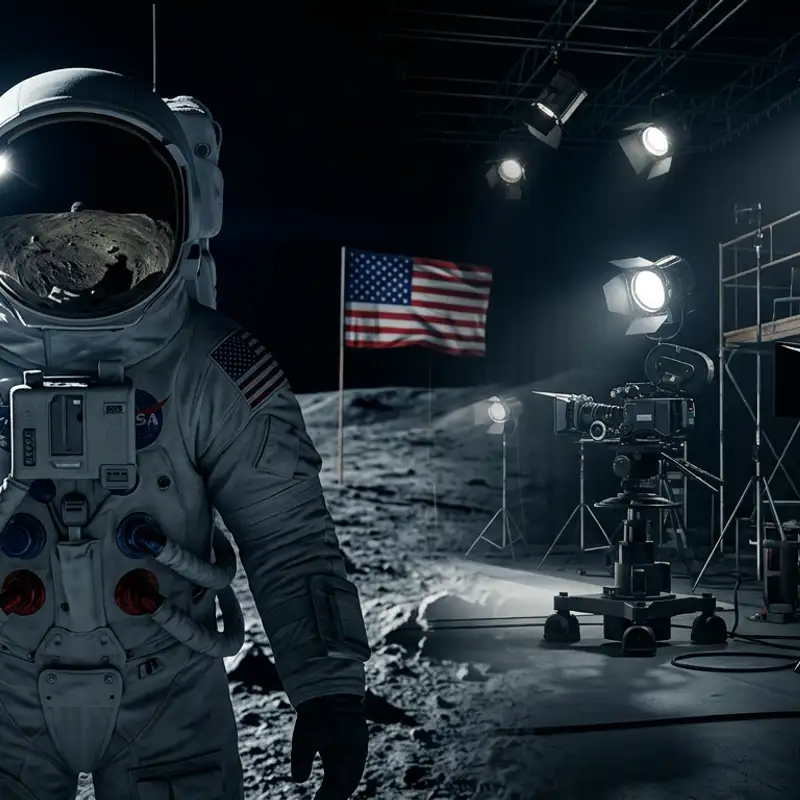
The most iconic "evidence" of all: the American
flag planted by Armstrong and Aldrin, appears to
ripple and move in the video footage.
The Moon has essentially no atmosphere, and therefore
no wind.
So how can a flag move unless it
was filmed on a soundstage with a
fan just out of frame?
Second, the missing stars.
None of the thousands of photos taken on
the lunar surface show a single star against
the black sky.
Even though the astronauts themselves described being able
to see stars with the naked eye.
For skeptics, the logic is simple.
If you are on the Moon at night
with no atmosphere to obscure the light, the
sky should be full of stars.
That empty, black void
around them looks more like a painted studio
ceiling.
Third, the shadows.
In several photos, shadows from different objects appear
to point in seemingly different directions.
Not parallel, as you would expect with one
light source, the Sun.
The conclusion, according to critics, is that
there must have been multiple artificial light sources at
play, like a film set.
The Van Allen radiation belts.
Between Earth and the Moon lie two belts
of intensely trapped electromagnetic particles, discovered by the
physicist James Van Allen in 1958.
According to several of the sources in my
research, including Bart Sibrel's documentary "A Funny Thing
Happened on the Way to the Moon" — a
human body passing through these belts without massive
lead shielding would have been killed or severely
injured by the radiation.
The spacesuits and capsule walls of the
era were, according to this theory, far too
thin.
Lastly, there is the missing crater.
The lunar module's descent engine should, according to
the laws of physics, have generated a powerful
downward blast at landing, enough to create
a visible crater, or at least a clear
depression in the lunar dust beneath the engine
nozzle.
In the photographs, there is no crater, just
a flat, undisturbed surface right beneath the lunar
module's feet, as if it had simply been
placed there rather than landed.
That is the core.
The four or five claims that recur in
practically all 30 sources in my material, regardless
of language or country of production: the flag, the
stars, the shadows, the radiation, and the crater,
these are the shared international currency of moon
-landing skepticism.
But if you follow the trail further down
the rabbit hole, the story quickly gets more
colorful and more speculative.
Bart Sibrel, the man from our cold open,
claims to have found unreleased NASA footage showing
astronauts filming a fake "window trick" in low
-Earth orbit to simulate being "halfway to the
Moon" —
with a round window, a darkened cabin, and
a model of Earth.
He has confronted several Apollo astronauts directly with
these claims on camera.
From the same source material, a series of
even more dramatic threads emerge:
An anonymous security officer allegedly confessed on his
deathbed to having witnessed the fake landing being filmed
on a U.S. Air Force base in
1968.
The story that astronaut Gus Grissom, the one
from the Apollo 1 fire, was actually murdered
because he intended to expose problems in the
program to Congress.
A safety inspector named Thomas Ronald Baron, who
testified critically about safety deficiencies in the Apollo
program before Congress and died in a
car accident a week later — portrayed in several of
our sources as a silencing assassination.
And then there is Stanley Kubrick's theory that
the director who made "2001: A Space Odyssey"
that same year was secretly hired to film
the fake moon landings using the era's most advanced
special effects.
And he left hidden confessions embedded in his
later film "The Shining."
At the most extreme end of the material
I reviewed is a Russian video categorized as
"sensationalist" in my research.
The moon-landing theory melds together with
entirely different conspiracy threads: that NASA was founded
by former Nazi SS scientists brought over
through Operation Paperclip, that Armstrong and Aldrin were
high-ranking Freemasons who performed a secret ritual
on the Moon, and that the real motive
behind the hoax was concealing the truth about
extraterrestrial life.
It's worth noting how differently these threads carry
weight.
Some, like Sibrel's confrontations, are documented on video
and can be checked directly.
Others, like anonymous deathbed confessions and murder theories
with no forensic documentation, rest on loose, unverifiable
anecdote.
And the most extreme versions with Freemasons and
Nazis are essentially conspiracy-theory collages using the
moon landing as glue for entirely
separate narratives.
So what does the physics say, and what
do the independent data say?
If we start with the flag, according to
NASA and several space centers, including the UK's National
Space Centre, the flag moves because the astronauts
themselves twisted the flagpole back and forth to
get it into the ground, not because of
wind.
Without air resistance to dampen the motion, the
fabric keeps swinging longer than it would on
Earth.
The flag also had a horizontal extension rod
that couldn't always be fully extended, which created
permanent creases that look like movement
in still photos.
Importantly, in all the continuous footage, the flag
sits perfectly still whenever the astronauts aren't
touching it.
If we look at the missing stars, the
cameras were set for short exposure times because
the primary job was photographing the intensely sunlit
surface and the astronauts themselves, not the night
sky.
At short shutter speeds, film simply doesn't register
the faint light from distant stars.
the same way an ordinary camera photographing a night
sky without a long exposure won't pick up stars
either.
The same holds true for astronauts on the
International Space Station today.
Their photos don't show stars either.
If we look at the shadows, what look
like non-parallel shadows is a perspective effect —
the same phenomenon that makes railroad tracks appear to
converge on the horizon, even though they're
actually parallel.
Combined with the fact that the lunar surface
is uneven, full of hills and depressions that the shadows
follow. Shadows from the same light source can
easily appear to point in different directions when
photographed from ground level.
Then we have the Van Allen belts.
Here NASA has concrete measurement data.
Every Apollo astronaut wore a personal radiation dosimeter
for the entire mission.
The recorded doses ranged between 0.16 and
1.14 rad for the whole round trip,
far below the threshold where radiation becomes
harmful,
which is in the hundreds of rads —
and roughly on par with a person today
would get from a single CT scan.
The key is that the Saturn V rocket
flew through the finish zones of the build
at a very high speed, only about an
hour in total.
And that the spacecraft's metal hull itself provided
shielding, James Van Allen, the man who discovered
the belts and had them named after him,
personally called the claim of lethal radiation "
nonsense."
The missing crater.
The lunar module's descent engine operated at relatively
low thrust and was designed to reduce speed
gradually, not to slam down with full power.
In the final phase of landing, while the
engine was still firing,
The module hovered just a few meters above
the surface with a relatively gentle push.
Nowhere near strong enough to dig a crater into
the compacted lunar soil, which incidentally is far
firmer than loose sand.
And then there is the evidence the conspiracy
theory simply can't argue its way around.
In 2009, NASA sent the Lunar Reconnaissance Orbiter
into orbit around the Moon.
From altitudes as low as 20 kilometers,
it has photographed every single Apollo landing site
in sharp detail.
The lower sections of the lunar modules, still
standing there, rover tire tracks, and astronaut footprints
crisscrossing the surface in patterns that precisely match
the original mission logs.
But NASA isn't the only one who seems
to have seen it.
India's Chandrayaan-1 probe, Japan's Kaguya, and
China's Chang'e missions have all independently photographed
parts of the lunar surface, including areas near
the Apollo landing sites, built and launched by
nations that had zero political interest in confirming
an American hoax story.
Even more tangible: at three of the Apollo landing
sites, astronauts left behind small mirror panels called
laser retroreflectors.
They're still there.
They still work.
Scientists around the world at observatories in the
U.S., France, and elsewhere continue firing lasers
at them and measuring how long the light
takes to bounce back, calculating the Earth
-Moon distance to within millimeters.
They were placed there by people standing on
the surface — not robots, as some of
my sources claim.
The Soviet Lunokhod rovers had their own,
separate retroreflectors.
Finally, the 382 kilograms of lunar rock and
soil the astronauts brought home have been analyzed
by hundreds of independent laboratories in the decades
since, including labs in countries with zero incentive
to confirm the American story.
The isotopic composition doesn't match any known material
from Earth. And a statistical analysis published in
the scientific journal PLOS ONE concluded that a
hoax of this scale would have required more
than 400,000 people in on the secret, without
a single documented leak in over 55 years.
Last but not least, in 2008, the American
TV show MythBusters put several of the classic
claims under the microscope in a dedicated episode.
The flag, the shadows, the missing stars, the
reflected light.
Using physical experiments, not just arguments, they concluded
that every claim they tested could
be explained by ordinary physics.
Let's be honest about what we have here.
The five classic "pieces of evidence" — the flag,
the missing stars, the shadows, the radiation belts,
and the crater, are all well-documented physical
phenomena with concrete, checkable explanations backed by NASA's
own measurement data and independent international research.
These belong in the well-documented category.
The independent spacecraft imagery from four nations and
the still-functioning retroreflectors are likewise well-documented
evidence that there is, in fact, human-made
equipment sitting on the lunar surface.
Not because NASA says so, but because countries
that have no interest in confirming the American
story photographed it by themselves.
Bill Kaysing's 0.0017% figure is weakly
substantiated.
The source does not exist, and the number
is directly contradicted by NASA's own contemporary survival
calculations.
Bart Sibrel's confrontations with astronauts are documented on
video and can be watched directly.
But his interpretation of what the footage proves remains
speculative, since the underlying claims about hidden NASA
footage has never been independently verified by any
third party.
The anonymous deathbed confessions, the murder theories about
Grissom and Baron, and the Kubrick theory are speculative
to weakly substantiated —
they rest on anecdote with no forensic
or documentary support, and in several cases like
circulating "Kubrick confession," has since been directly exposed
as staged mockumentaries.
The Nazis, the Freemasons, and the UFO add
-ons to the theory belong at the most
extreme, least source-critical end
of the spectrum can still be classified as
weakly substantiated at best.
And what about Thomas Ronald Baron's
fatal accident?
Here we should be honest that there is
a real documented element.
Baron really did testify critically about safety
deficiencies before Congress shortly before the Apollo 1 fire, and
he really did die shortly afterward in a car
accident.
The connection between those two events, and whether
the accident was anything other than an accident,
is not definitively settled in the publicly available
material.
we place that in the unresolved
category: not disproven, but not
proven either.
So where does that leave us?
The physical and technical core of the moon
landing conspiracy theory, the flag, the missing stars,
the shadows, the radiation, and the crater, have
been thoroughly investigated, tested, and explained by independent
physicists, TV shows like MythBusters, and not least
by NASA's own archived measurement data.
And the evidence that people were really there
is no longer just American: it comes
from India, Japan, and China, from nations
with absolutely no reason to confirm an
American story if it were false.
But it would be dishonest to pretend that
the whole theory is just about physics.
It's also about something more human: a deep,
understandable distrust of authorities that have historically lied,
Vietnam, Watergate, later revelations about surveillance.
It's about how hard it is for a layperson
to tell the difference between a poorly explained
detail and an actual deception.
And it's about how satisfying it is, on a
human level, to believe that a small group
can uncover what hundreds of thousands are supposedly
hiding.
Bart Sibrel still believes his theory.
Buzz Aldrin, who passed away in 2024, as
one of the last living Apollo astronauts,
never grew tired of defending what he'd seen
with his own eyes, from the surface
of the Moon.
And somewhere in between stands the rest of
us, with access to more data than
ever before, and a choice about what to
believe.
When the history and the physics are actually
available to all of us. That's where I want
to leave you today. Not with proof. With
a question about what it actually takes before
we call something true.
And speaking of names that are hard to get
it right, my own included.
My name is René, and I know that
to an American ear, it can look like it
should rhyme with something it doesn't.
If you have been quietly
pronouncing it "Reen" or "Wren"
the whole episode, don't worry, you are in
good company, and I promise I won't
hold it against you.
Thank you for listening, and see you in
the next episode.