November 20, 1969.
The astronauts of Apollo 12 have already left
the lunar surface.
Pete Conrad and Alan Bean are back with
Richard Gordon, and the small ascent stage that
had carried them up from the Ocean of
Storms no longer has a crew to protect.
It has one last job.
The Mission controllers send it back down.
The little spacecraft falls toward the Moon and
strikes the surface about 40 miles from the
scientific station or should I say the seismic
station that the astronauts left behind.
The impact is deliberate.
It is a calibration shot on a planetary
scale:
Engineers want to know the mass sorry they
know the mass, they know the approximate velocity,
and they know where it will hit, and
a seismometer is waiting.
On Earth, researchers watch for the time signal
If you have spent your career looking at
earthquakes, you might have expectations.
An impact injects energy into rock.
Waves spread outward.
The strongest motion passes.
The signal decays.
But this signal did not behave like a
familiar terrestrial earthquake.
It builds.
It scatters.
It keeps going.
Minutes pass.
The lunar ground is still vibrating.
The energy does not disappear neatly into a
noisy, wet, active planet because it's not like
Earth.
The Moon is dry, cold, battered, and fractured.
Seismic waves ricochet through that structure, arriving by
many paths and at many times.
The result is a long, strange coda— a
fading tail of vibration that lasts on the
order of an hour.
The comparison that enters the popular culture is
irresistible:
The Moon rang like a bell.
And once that phrase exists, another question is
almost guaranteed to follow.
What kind of object rings when you hit
it?
A bell is not a solid ball.
A bell is a shell around an empty
space.
That is the doorway into tonight’s mystery. Because
the Apollo result is real.
The long vibration is real.
Later impacts produced even longer signals.
The question is not whether NASA recorded something
unusual.
It did.
The question is that what are we entitled
to conclude from it.
Was Apollo listening to an unexpectedly dry and
fractured world?
Or did those astronauts accidentally strike the outer
shell of something much stranger?
I’m Ren, and this is Lost Civilizations: Ancient
Aliens and Forgotten History.
Tonight: why the Moon rang like a giant
hollow bell— and what a scientific surprise became
evidence, for some people, that the Moon may
not be what we think of it
Why Are We Still Talking About It?
Well There are mysteries that survive because the
evidence is missing.
This one survives almost in the opposite reason:
The evidence is easy to find, but the
metaphor is stronger than the explanation.
NASA really did put seismometers on the Moon.
Spacecraft really were crashed into the surface.
The signals really did persist for an extraordinary
lengths of time.
NASA historical material itself uses the language like
rings like a bell,” and later NASA and
JPL discussion goes one step further and says
that, compared with Earth, the Moon behaves more
like a gong.
That matters, because it is not a legend
invented decades later by a UFO magazine.
The strange part is embedded in the history
of the lunar science. But a metaphor can
quietly change the categories
Rings like a bell” begins as a way
to describe a seismic waveform.
It becomes behaves like a bell.” and Then,
online, it becomes it's hollow like a bell.”
Those are three different statements.
The mystery also survives because the Moon is
familiar enough to feel ordinary and unusual enough
to resist that familiarity.
It's enormous in our sky.
It controls the rhythm of tides.
Its face is locked toward us.
During the right eclipse, it can cover the
Sun with astonishing precision.
Its far side looks dramatically different from its
near side.
Ancient cultures used it to measure months, structure
calendars, time rituals, and tell stories about death,
rebirth, fertility, madness, the gods.
So when humans finally went there— and
when the first scientific instruments told us that
apparently a deaf world was not seismically silent.
Deep moonquakes repeated. Meteoroids struck. The surface
responded to enormous temperature swings. Shallow quakes occurred.
Artificial impacts traveled through the ground in a
way that surprised people who were used to
this on Earth.
That combination is almost designed to produce mythology:
a familiar object, a real anomaly, a vivid
face and a scientific explanation that is less
intuitive than the mystery.
And there there's another reason for the story
to persist
The hollow moon theory is rarely built from
the seismic result alone.
Its a cumulative
It supports one unusual feature on another:
Density, orbit, eclipses, craters, base clouds ancient stories,
reports of light structures in photographs, and the
ringing itself.
Any one piece can be explained away, they
are due But can they all be argued
away
That is the strongest form of the question.
And that deserves a better answer than either
that NATO proved that the Moon is hollow”
or that’s ridiculous.”
So we are going to do this in
this order.
First, the ordinary scientific story. Then the cracks
people see in it. and Then, for a
while, we are going to enter the alternative
theory without interrupting it.
Only after then we will test the case.
The step is slowing
The mainstream scientific picture begins with something that
is already dramatic enough:
The Moon is probably formed from a catastrophe.
The leading family of models traces moon origin
to the early solar system, when the young
Earth experienced a giant collision with another planetary
body.
Material thrown into orbit later accreted into the
Moon.
The details have changed over time as isotope
measurements, computer simulations, and high precision geochemistry have
improved,
But the central idea is that the earth
moon system emerged from a violent planetary formation,
and not from a quiet little satellite simply
condensing where we see it today.
The Moon is differentiated.
It has a crust, a mantle, and a
small core.
It is not compositionally uniform, and it's not
simply a miniature Earth.
Its average density is about 3. 34 grams
per cubic centimeter, far below the earth roughly
5. 5. That sounds dramatic until we remember
that Earth’s bulk density includes a much larger
iron-rich core and a substantial compression at
depth.
The Moon is smaller, less compressed, and proportionally
poorer in iron.
Its surface tells another part of the story.
The bright highlands are ancient and heavily cratered.
The darker maria are enormous plains of basalt,
the products of an ancient volcanism that filled
major impact basins.
The near side contains far more of those
dark plains than the far side,
One of the most obvious asymmetries visible in
lunar geology.
By the time Apollo, scientists knew a great
deal about the surface from telescopes and from
robotic probes, but the interior remained uncertain.
Seismology offered a way in.
Apollo 11 carried the first seismometer placed by
the astronauts, though its solar-powered operation was
limited.
Apollo 12 established a longer lift station.
Apollo 14, 15, and 16 added instruments, creating
a network on the near side.
The stations listened from 1969 until the network
was shut down in 1977.
The instruments recorded several broad families of events.
There were deep moonquakes, many of them repeating
from the same source regions and strongly associated
with tidal cycles.
There were shallow moonquakes, less common but sometimes
relatively strong.
There were meteoroid impacts.
There were thermal events associated with the brutal
transition between the lunar night and day.
And then there was the artificial impacts, that
NASA deliberately sent a known spacecraft hardware into
the surface.
Those artificial impacts were especially useful because they
came with information nature rarely provides.
Researchers could estimate the mass, the speed, time,
and location of the impactor.
The Moon became a controlled seismic laboratory.
The Apollo 12 lunar ascent stage struck November
20, 1969. and NASA historical summaries describe the
resulting vibration as lasting more than 55 minutes.
The signal did not simply spike and vanish.
It rose gradually toward a peak and then
decayed slowly.
Then came a larger experiment.
On April 14, 1970, the Apollo 13 S
Saturn V third-stage rocket hit the Moon.
The Apollo 13 mission report gives the impact
speed as about 5, 600 miles per hour
and the remaining stage weight about roughly 30,
700 pounds.
The report estimates an energy release equivalent to
7. 7 tons of TNT.
Seismic signals reached the Apollo 12 station less
than half a minute later and continued for
more than four hours.
Peak intensity came about ten minutes after the
onset.
That is astonishingly long seismic coda
But it does not mean that's hollow.
On Earth, seismic waves lose energy through several
processes.
They spread geometrically. They shake gather They are
absorbed and converted into heat.
Fluids, cracks, temperature, mineral behavior, and active geology
all affect the attenuation.
The Moon presents a very different medium: a
dry rock, an intensely impact-fractured outer
the shell, and a regolith that has been
pulverized by billions of years of bombardment.
A useful mental image is not a perfect
metal bell.
It's a gigantic, dry, cracked body with seismic
energy takes bewildering number of paths.
Waves bounce, scatter, and arrive late.
Instead of a clean Earth-like pulse, the
seismometer seems to be a long train of
energy.
Modern work supports this basic picture.
Quantitative studies describe intense seismic scattering as one
of the defining features of the Apollo lunar
data and connected to the subsurface
Researchers are still mining the old recordings.
In 2024, a new analysis of a short
period Apollo data reported tens of thousands of
previously unrecognized seismic events, including thermal events, impacts,
and shallow moonquakes
The Moon did not become less interesting when
the hollow interpretation was rejected.
It became more geologically alive.
And that is the established story: a differentiated
rocky Moon, a small core, a fractured and
dry crust, and an unusual persistent seismic energy.
It's a coherent explanation. But when you first
encounter the data without that framework, it's easy
to see why somebody hear something else.
If we look at The First Cracks we'll
Start with the sentence itself:
The Moon rang like a bell.
If you know nothing else, the analogy suggests
a bell a shell.
That intuition becomes stronger when you hear that
the vibration lasted not seconds, but close to
an hour
In one famous case and more than four
hours in another.
The mind reaches for familiar objects. A solid
rock dropped on the ground gives a dull
response.
A hollow metal object resonates. Then comes density.
The Moon is much less dense than the
Earth.
Again, there are standard planetary reasons for that.
But in an alternative reading, low density becomes
the first physical clue that there might be
less material inside than the exterior dimensions imply.
Then tidal locking.
The Moon rotates once in roughly the same
time as it orbits Earth, so one hemisphere
remains generally pointed toward us.
Science explains this as the long-term result
of tidal interaction. Yet visually, it is uncanny.
Humanity evolved beneath a comparison that one that
keeps one face turned toward Earth as a
soft position
Then eclipses.
The Sun is about 400 times wider than
the Moon but is also about 400 times
farther away, which means that the apparent sizes
in our sky is remarkably similar.
That coincidence allowed a total solar eclipses in
which the lunar disk can be covered the
bright solar photosphere while revealing the corona.
The match does not it's not exact, and
it changes because both orbits vary,
But as a human experience it's hard to
find that not to be extraordinary.
Then there are the mascons the mass concentrations
discovered through their effects on spacecraft trajectories.
Some lunar basins contain gravitational anomalies strong enough
that early lunar orbit calculations had to account
for them.
To planetary scientists, mascons are evidence about basin
formation,
Crustal structure, and dense material beneath the impact
sites.
In the alternative literature, they became something more
suggestive: like hidden concentrations of unusually dense material
beneath a world those in overall density is
comparatively low.
Then craters.
Popular hollow moon arguments often say that the
large lunar craters are surprisingly shallow relative to
their width, as though enormous impacts encountered a
stronger layer beneath the surface.
Geology explains the crater depth through collapse, melt,
ejecta, basin modification, and the behavior of the
rock immense scales.
But again, the visual impression is powerful:
Giant scars spread laterally across the Moon without
looking like bottomless punctures.
Then there's the far side.
It's not a dark side”;
It receives sunlight just as the near side
does. But it remained unseen by the human
eyes until the space age,
And when the spacecraft photographed it, the terrain
looked different—
Fewer broad maria, more highlands, small densely cratered
terrain.
A natural satellite can absolutely have a hemispheric
asymmetry. Yet for people already suspicious of the
Moon, the hidden face became a part of
the pattern.
And finally, there are stories of transient lunar
phenomena: flashes, glows, hazes, color changes, and other
short-lived observations reported over centuries.
Some reports likely involve observational effects, impacts, outgassing,
lighting geometry, or poor historical documentation.
But to supplied one more category of anomaly.
None of these observations proves artificiality.
But before we criticize the theory, notice that
why it has the staying power.
It does not begin with one impossible claim.
It begins with a collection of real things
that feel improbable when placed side by side.
A large Moon. A low-density Moon. A
tidal-locked Moon. A Moon that can precisely
cover the Sun. A Moon that which the
unusual gravity anomalies. A Moon with a hidden
hemisphere unlike the visible one. A Moon whose
seismic signals can persist for hours.
At this point the alternative theorist asks a
simple question:
How many coincidences are we willing to call
coincidence?
And Now I think we are really ready
to hear that case in full.
The Alternative Theory: is that The Moon as
a Constructed World
For this section, we are going to stay
inside the alternative theory and let it make
its case on their own terms.
The theory begins with the Apollo impacts because
they offer something unusually concrete.
This is not a medieval legend or a
blurry photograph.
A known object hit the Moon.
A scientific instrument recorded the response.
The response lasted far longer than an ordinary
person would expect from a solid rocky body.
Apollo 12 ascends the age struck with an
energy often summarized as roughly a ton of
TNT.
The lunar seismic signal persisted for close to
an hour.
Apollo 13’s is larger
Saturn 4b impact generated a signal that lasted
for hours.
Later controlled impacts added more data.
The Moon did not respond like the Earth
The hollow moon interpretation, is this is the
signature of resonance.
Imagine striking two objects with the same outside
dimensions.
One is rock solid
The other one is a shell.
The solid block transmits a shock, but a
shell a labrador shell can sustain organized vibration.
The Moon’s long seismic coda is therefore threatened
as not merely as unusual attenuation but as
the behavior of a body whose internal architecture
is fundamentally different from its exterior suggests.
From there, the argument turns to density.
The Earth average density is roughly 5. 5
grams per cubic centimeter.
The Moon’s is about 3. 34. The standard
explanation emphasizes composition, compression, and Earth’s large metallic
core.
The alternative reading asks whether the simplest visual
interpretation is being ignored:
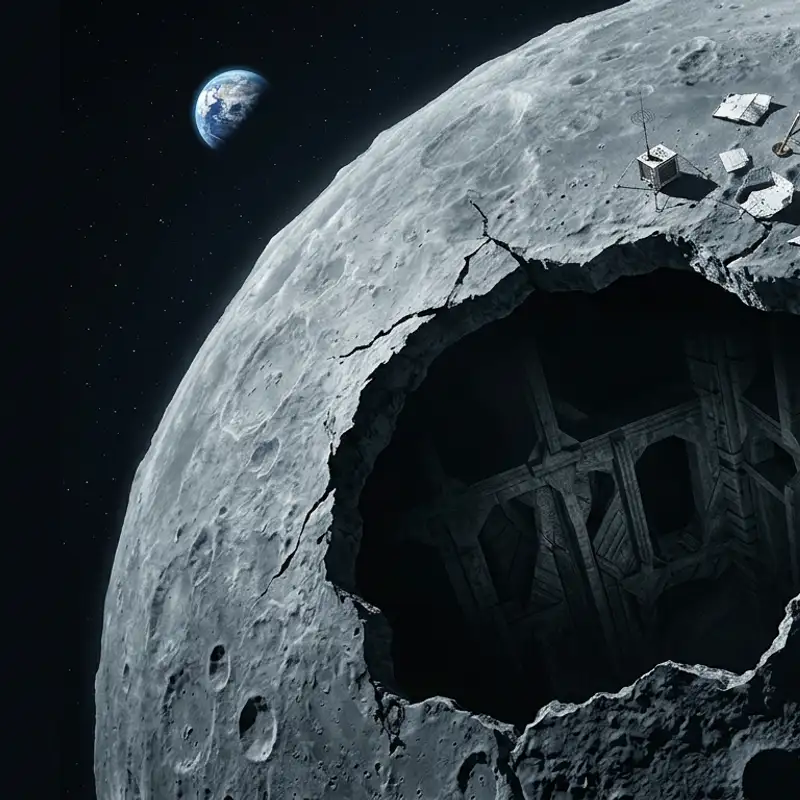
Perhaps the Moon is less dense because the
part of of its interior contains large voids
or engineered spaces.
The theory does not always require the Moon
to be completely empty.
In its more sophisticated versions, hollow” means structurally
hollow in the way of a vessel, station,
or a layered megastructure that contain substantial material
while also containing enormous cavities.
A battleship is not empty.
A city is not empty.
A spacecraft is not empty.
Yet none is a solid mass from the
surface to the center.
That distinction matters because critics often attack the
easiest version:
A paper-thin lunar shell surrounding a giant
vacuum.
The alternative case can instead propose a thick
natural looking outer layer over deeper structural cavities,
reinforcing the layers, dense machinery, or internal chambers.
Next comes the Moon’s relationship to the Earth.
It is unusually large compared with its primary
planet.
Pluto and Charon form an even more extreme
pairing,
So size ratio alone is not unique.
But the Earth’s surface, our Moon dominates the
night sky in a way that has shaped
every human culture.
Its gravitational influence stabilizes important aspects of Earth’s
axial behavior over long time scales and drives
the powerful tides.
To supporters of the artificial moon idea, the
question becomes not merely whether a large Moon
can form naturally, but whether Earth’s unusually favorable
environment was helped by the presence of this
particular companion.
The Moon is also tidally locked.
The same hemisphere faces Earth, apart from libration
that lets us glimpse somewhat on half the
surface over time.
The Standard celestial mechanics explains this as a
common endpoint of tidal evolution. But the alternative
interpretation, that it has an operational advantage:
A permanent Earth-facing side and a permanent
far-side region side shielded from terrestrial radio noise.
If the Moon were an observation platform, the
geometry would be very useful.
Then there is the eclipse coincidence.
The Sun’s diameter is roughly 400 times the
Moon’s, while the Sun is roughly 400 times
farther from the Earth.
The numbers are approximate, not exact, and the
apparent sizes vary.
But for the results it's in this particular
phenomenon is of total solar eclipses.
From the inside of the alternative theory, this
is not treated as a proof itself.
It is treated as a precision geometry in
the same system that already contains an unusually
large satellite and synchronous rotation.
The question is cumulative:
What are the odds for the one natural
companion would have all these properties at the
same epoch
Which technological species emerges to observe them?
The next line of argument concerns the lunar
surface.
The Moon has suffered impacts energetic enough to
excavate enormous basins.
Yet are the theory points to the relationship
between the greater width and the depth and
argues that the surface often appears to have
spread impact energy sideways rather than allowing penetration
to continue downward without limit.
In the engineered moon model, the regolith and
the crust could be sacrificed as outer layer,
while a deeper shell of a stronger material
resist the penetration.
This idea is often connected to the soviet
area Spaceship Moon” hypothesis associated with Mikhail Vasin
and Alexander Shcherbakov.
The broad concept is that an advanced civilization
could have hollowed out or constructed massive body,
covered it with protective rocky layer, and maneuvered
into orbit.
Micrometeorite bombardment over geological time would then create
an exterior increasingly difficult to distinguish from a
natural world.
The Moon’s gravitational anomalies are folded into the
same picture.
Mascons beneath large basins are real.
Spacecraft navigation had to account for them.
The alternative theory is asked whenever these dense
concentrations could represent structural components, reinforcement, or
material unlike the surrounding crust.
Again, the argument is not a single any
single mascon looks like a machine.
It is that a low density body contains
localized regions of excess mass, exactly as the
sort of distribution one might expect from a
complicated internal structure rather than a simple homogeneous
sphere.
Then comes the seismic wave paths.
Apollo data revealed that the moon is not
seismically simple.
Deep moonquakes occur hundreds of miles below
the surface.
Many repeat from specific source regions and track
tidal stresses.
Shallow moonquakes occur closer to the surface.
Impacts generate extended godas and The alternative theorist
sees this as a paradox:
If we can locate deep events and infer
layers, why did the physical impacts behave so
unlike
Familiar on terrestrial seismic sources?
The answer offered is that the Moon has
two faces in the data.
Some wave behavior can be modeled as a
rock.
Other behavior resembles resonance.
A constructed body covered by geological material could
produce both.
This is where the phrase ring like a
bell” becomes central.
In ordinary speech, bells ring because they have
a coherent structure and low damping.
The Moon, too, has a low damping.
Its seismic energy persists.
If the only explanation where are dry fractured
rock,
Supporters ask, why was the results from not
surprisingly to the scientists who first saw it?
Why did the bell comparison emerge at all?
The alternative answer is that the comparison emerged
because the physical behavior really needs to resemble
a resonant object.
Now add the Moon’s surface asymmetry.
The near side has a broad basaltic maria.
The far side is dominated by the thicker
highland crust and has far less mare volcanism.
In an engineered interpretation, different hemispheres could have
different structural functions or shielding requirements.
The earth facing side could have experienced with
different thermal, cohesion or operational history than the
far side.
The theory explains sorry expands from engineering to
chronology.
Was the Moon always here?
Human mythologies contain stories of heaven
Heavens change, of god reordered the sky, or
a new celestial age begins.
Some alternative writers have collected traditions they interpret
as memories from a time before the Moon
or before the Moon’s arrival.
The details vary enormously, and the stories come
from different eras and cultures.
Within the theory, however, they are treated as
cultural fossils:
Distorted memories of an astronomical event preserved after
the original technical understanding was lost.
That possibility changes the scale of the story.
The Moon would not merely be artificial. It
might have been placed here within the memory
of intelligent beings— or even within the distant
cultural memory of humanity.
Then ancient Mesopotamia enters the argument.
Modern alternative media often claim that the Sumerian
or Babylonian texts describe celestial beings, sophisticated astronomy,
and a Moon understood as a vessel or
constructed object.
In this reading, terms associated with gods or
heavenly beings are treated as descriptions of technologically
advanced visitors.
Celestial myths become records of planetary engineering.
The Moon becomes not a deity in a
poetic sky but a physical object associated with
those beings.
The attraction of this interpretation is obvious.
If ancient texts really contained technical knowledge about
the Moon that could not have been obtained
without advanced instruments,
Then moon seismic results would look less like
20th twentieth-century surprise and more like a rediscovery.
The theory also draws strength from the history
of space exploration itself.
Apollo was conducted in a Cold War environment
where national security, classified reconnaissance, military technology, and
public science existed side by side.
That does not mean lunar science was fake.
It means that secrecy was normal in every
institutions surrounding the space program.
For someone already persuaded that the Moon produced
anomalous results, that context makes official silence easier
to imagine.
If astronauts or instruments encountered something genuinely artificial,
would they put the information necessarily have been
released immediately? Or would have been filtered through
military and political structures?
From there, photographs become evidence. Enthusiasts point to
unusual shapes, lights, geometric forms, shadows, and features
that appears as physical in certain images.
Some are in low resolution Some have been
copied repeatedly. Some are enhanced. But which in
the common case, they serve as visual echoes
of the seismic argument:
The Moon does not merely have behaved strangely;
it sometimes looks strange.
The theory can then even absorb the absence
of obvious machinery.
If the Moon is ancient, its outer surface
should look ancient.
A civilization capable of moving a lunar scale
object would also have capable of hiding its
engineering beneath kilometers of rock.
Expecting exposed metal doors and antenna towers would
like the expectation of the internal steel of
a skyscraper to be visible through the its
concrete facade.
The strongest version of the hollow moon theory
is therefore not depend on one photograph, one
quote, or one mistranslated tablet.
It's an architectural hypothesis built from converging anomalies.
The Moon’s density is lower than Earth’s. Its
seismic energy persists unusually long. Its orbit and
rotation create an enduring Earth-facing geometry. Its
apparent size creates extraordinary eclipses. Its gravity field
contains concentrated anomalies. Its near and far sides
are strikingly different. Its surface preserves billions of
years of bombardment while its deep interior remains
accessible only indirectly.
Ancient cultures treated it as far more than
a rock in the sky.
And then the human finally struck it with
a known objects and listened, it answered in
a way scientists themselves described with language of
resonance.
From inside this theory, the conclusion is not
that one strange reading proves a spaceship. The
conclusion is a natural explanation asks us to
accept a long chain of unusual coincidences, while
the engineered explanation ties them together.
The Moon rings because it's structurally resonant. It
is light because it contains internal volume and
not filled with ordinary rock. it looks it
like It is locked because its orientation is
intentional or useful. Its surface is battered because
the exterior is armor, shielding, camouflage, or the
simple ancient accumulated geology. Its mascons are dense
internal structures. Its perfect looking eclipse is a
part of the placement geometry. And the oldest
stories may preserve memories of the builders, operators,
or arrive the object itself.
If you accept those premises, the Moon stops
being a satellite with a few odd properties.
It becomes the largest physical in the human
sky.
If you go Down the Rabbit Hole then
Once the Moon has become a possible artifact,
almost every lunar mystery is put to work
In The modern Spaceship idea often linked to
a 1970 article by Soviet writers Mikhail Vasin
and Alexander Shcherbakov. Their proposal is remembered because
it reverses the normal question. Instead of asking
how a natural Moon acquired a few strains
ask what an engineered Moon would look like
after immense time in space.
It would need protection from radiation and impacts.
Rock is excellent shielding. A thick outer layer
could be deliberately added or could accumulate and
transform over time.
The interior could contain structural shells and cavities.
Large impacts might scar the surface without destroying
the deeper framework.
From a distance, the object could become indistinguishable
from a natural satellite.
This concept arrived at exactly the right historical
moment.
Apollo had just begun returning direct geophysical data.
The public was seeing the lunar surface in
an unprecedented detail.
Science fiction had normalized generation ships, alien megastructures,
and artificial planets.
And the face about the Moon ringing like
a bell gave the idea to a physical
hook.
Then the story started collecting material.
One branch focuses on the ancient texts.
Here we need to be careful about what
belongs to the theory rather than what has
been established.
Alternative writers frequently connect the Sumerian religion, the
Anunnaki, Mesopotamian astronomy, and the Moon.
In the most expansive version, ancient cuneiform is
said to preserve engineering descriptions of celestial bodies
and even technical knowledge of its orbital mechanics.
That claim is powerful because it creates a
bridge across 4 000 years:
Ancient scribes allegedly describe an artificial Moon;
Apollo later strikes the Moon;
The Moon rings.
Another branch focuses on pre-lunar” traditions.
Writers have cited ancient authors and in genealogical
stories as evidence that some people remembered a
sky without the Moon.
The face before the Moon” can appear in
mystic in genetical or poetic contexts, and alternative
researchers sometimes interpret it literally.
If even one well-documented tradition independently preserved
an astronomical memory of a lunar arrival within
the human time scales the consequences would be
enormous.
If It would collide with the celestial mechanics,
geology, archaeology, and the entire chronology of the
Earth-Moon system.
A third branch concerns lunar lights and transient
phenomena.
Before spacecraft, astronomers occasionally reported temporary bright spots,
hazes, reddish glows, or changes on the lunar
surface.
Catalogs of transient lunar phenomena exist.
The alternative theory asks whether some could report
could represent activity rather than geology: exhaust, illumination,
doors, vehicles, or energy releases.
A fourth branch concerns astronaut testimony.
Over decades, stories have circulated about unusual objects
seen during the Apollo missions,
Coded language, missing tapes, edited photographs, and private
warnings.
Some accounts can be traced to ordinary mission
events or later retellings;
Others are difficult to source cleanly. But inside
the rabbit hole, the ambiguity itself becomes evidence
of institutional control.
This is a familiar pattern in conspiracy narratives,
but it's not automatically irrational to ask about
classification.
Apollo technology developed inside a national security ecosystem.
The United States and the Soviet Union both
concealed military capabilities during the Cold War.
Intelligence agencies operated space assets.
Reconnaissance satellites were classified.
The historical existence of secrecy makes hypothetical secrecy
psychologically plausible.
The problem is that plausible secrecy is not
evidence for a particular secret.
Still, we are not criticized yet. So stay
on with the theory.
Suppose a young nonhuman civilization wanted a
long time platform near Earth.
Where would you put it?
A satellite offers advantages.
It's outside Earth’s weather.
It can remain for geological time scales
It has a low gravity.
It offers limit of sight access to large
parts of the Earth over time.
A tidally locked body provides stable hemispheric orientation.
The far side offers shielding from Earth’s radio
emissions.
The surface can support observatories.
The interior can provide radiation protection.
A lunar scale platform would also solves the
problem with longevity.
Machines on Earth face erosion, tectonics, oceans, biology,
corrosion, and civilization.
On the Moon, footprints can survive for millions
of years.
An underground installation could endure far longer.
Now imagine that the platform predates humanity.
Its builders disappear, depart, or stop communicating.
The object remains.
Impacts continue.
Dust accumulates.
Volcanism reshapes parts of the surface.
The original engineering becomes buried beneath geology.
Later intelligent life evolves on Earth and assumes
the object is natural because it has always
been there.
That is the seductive power of the hypothesis.
It explains why an artifact would not look
like an artifact.
And then Apollo arrives.
Human beings place instruments on the outer surface
and begin striking it.
The first results are not a clean metallic
tone audible through space;
There is no air to carry such a
sound.
What arrives is seismic data: long, reverberant wave
trains.
To a supporter of the theory, this is
exactly the kind of clue that an ancient
buried structure might reveal.
Not a dawn Not a flashing sign. A
physical response.
There is another seductive feature:
The theory turns absence into scale. If we
do not see obvious engineering,
The engineering must be deeper.
If gravity models show a core, the structure
can be surrounded by the core.
If seismic waves reveal layers, the physical components
can be among or beneath those layers.
If samples are ordinary rock, the outer covering
is ordinary rock.
That flexibility makes the theory difficult to kill—
but it also creates a danger.
A theory can accommodate
Every possible observation may stop making risky predictions.
Before we reach that problem, there is one
more modern development worth noting.
Lunar seismology is returning.
The Apollo network ended in 1977, but researchers
have never stopped working with the data.
Modern computing can recover events that were missed
when the tapes were first analyzed.
New missions are being designed to place seismometers
in the regions Apollo never covered, including areas
far from the old near-side network.
For the alternative theory, that is an exciting
for a simple reason:
A broader network could test whether the strange
scattering seen by the Apollo is global, regional,
deaf dependent or something else.
The old theory can finally face better instruments.
And that brings us to the point where
curiosity has become a discrimination.
Which parts of this enormous story come from
actual measurements?
Which come from reasonable influence
And Which come from metaphor?
And which entered the story because they were
too good to not repeat?
If we look at the critics yeah we
need to change mode
In The alternative theory has an uninterrupted hearing.
From here on,
The claim goes back under the same standard:
source, measurement, mechanism, and whether the conclusion is
actually required by the evidence.
Let's Start with the strongest point:
Did the Moon really ring.”
The problem is the leap from the long
seismic order to the hollow interior.
A seismometer does not record hollowness.
It records motion over time.
To infer structure, scientists analyze wave speeds, arrival
times, frequency content, attenuation, scattering, source location, and
how signals differ across stations and events.
The Apollo data are not one mysterious waveform.
They are years of recordings from natural and
artificial sources.
The long codas are real, but lunar seismology
has a physical explanation for them:
Extreme scattering and low attenuation in a dry,
fractured medium.
Modern quantitative network identifies
intense scattering as a defining characteristic of lunar
seismic data and attributes to its subsurface hysteric
energy
The Moon is not simply a cleaner version
of Earth.
Earth’s crust contains fluids and active geological processes
that absorb and reorganize seismic energy.
The lunar near-surface has been shattered by impacts
over immense time.
Waves that can take many paths, arriving repeatedly
and gradually.
That produces the drawn-out signal that sounds so
suggestive when summarized as ringing.”
There is also a common factual distortion in
the popular retellings.
Apollo 12 and Apollo 13 are sometimes merged.
The Apollo 12 ascent states impact is associated
with roughly an hour of vibration.
The Apollo 13 S-IVB impact
produced signals for more than four hours.
Online videos sometimes assign the multi-hour duration
to Apollo 12 or claim the signals to
being stronger for hours.
The primary mission documentation is more specific.
That matters because a theory is built on
anomalies should be unusually strict about that number
Next: we have the density.
Yes, the Moon is less dense than the
Earth. But low density does not imply a
giant void.
The Moon has much smaller metallic core fraction,
different bulk composition, and far less pressure-driven
compression because it's smaller.
Other rocky bodies may also vary in density.
If the Moon contained an enormous vacuum sufficient
to explain its bulk density, its moment of
inertia, gravity field, tidal response, seismic wave propagation,
and rotational dynamics would all have to remain
consistent with that structure.
Modern lunar geophysics shows not rely on density
alone.
Spacecraft gravity missions map how mass is distributed.
Laser ranging measures of the Moon’s rotational and
tidal response with extraordinary precision.
Seismic analyses constrain layers of and core properties.
These are independent techniques converge on different planetary
body, not with a thin shell around a
giant empty cavity.
That does not mean that every kilometer of
the interior is directly known.
It means that there are uncertainties”
Is not equivalent to a vast hollow interior
fits equally well.”
Next: we have the tidal lockinging.
Synchronous rotation feels designed because we experience as
a fixed phase But it's common in the
solar system.
Tidal friction transfers rotational energy until a stable
spin orbit relationship is reached.
Many major moons are tidally locked to their
planets.
The moon near side orientation is interesting, but
it's not a unique engineering signature.
Next: we have The eclipses
It appears that apparent size between the Moon
and the sun is genuinely beautiful.
It's also temporary on a geological time scale
The Moon is slowly receding from Earth.
In the distant past, it appeared larger;
In the distant future, total solar eclipses of
the present kind will cease.
Even today, the match is not constant.
When the Moon is farther away in its
elliptical orbit, we will get annular eclipses instead
of total ones.
A design placement argument therefore has to explain
why the geometry is approximate, variable, and epoch
dependent
Next: we have the crater depth.
Large impact craters do not behave like holes
punched into rigid material.
At planetary scales, rock flows and collapses under
enormous pressures.
Complex craters develop terraces and central peaks.
Giant basins undergo modification, melting, rebound, and later
volcanic filling.
A relatively shallow final basin does not imply
armored or shell beneath it.
Next: we have the mascons
Macarons are real and historically important. But they
are not mysterious blocks of unexplained metal.
They are gravity anomalies associated especially with the
large impact percents where dense mantle uplift, impact
melt, basalt fields and crustal thinning, and basin
structure can produce excess mass.
Modern gravity mapping has made the lunar gravity
field far more detailed than it was during
the early Apollo navigation.
If mascons were components of an engineered internal
skeleton, we would have that evidence that their
distribution, composition, or geometry is inconsistent with the
basin's geology.
In fact The mere fact that they were
mere dense is not enough.
Then we have the near side and the
far side difference.
It's real.
The far side crust is generally thicker, and
the distribution of volcanism is strongly asymmetric. But
natural planetary bodies are not required to be
symmetric.
Early thermal evolution, crustal thickness, impact history, tidal
effects, and the concentration of heat producing elements
can generate hemispheric differences.
Next: we have the transient lunar phenomena.
Historical reports exist, but there is a difficult
evidence class.
Telescopic observations are vulnerable to atmospheric seeing, lighting
geometry, contrast effects, instrument limitations, expectation, and
inconsistent documentation.
Some genuine transient events may occur—
Meteoroid impacts certainly do, and localized outgassing has
been discussed.
But moving from evidence from temporary light was
reported” to technological activity occurred” requires a much
stronger chain of evidence.
And Now the ancient text claims.
This is where the alternative case becomes much
weaker than the Apollo seismic story.
Popular internet scripts sometimes claim that Sumerian cuneiform
explicitly describes the Moon as a hollow engineered
vessel, using terms as equivalents of trajectory calculation”
or gravitational anchor point,” or records modern style
orbital mechanics thousands of years before modern science.
Those claims are extraordinary, but the source data
is usually poor.
The famous Mesopotamian creation epic Enuma Elish is
Babylonian, not a Sumerian engineering manual.
Its standard scholarly translations present a mythic cosmology
involving deities, conflict, and the ordering of the
heavens.
One can propose a technological reinterpretations of the
myth, but it is an interpretation.
It is not the same as demonstrating that
cuneiform contains modern engineering terminology.
The same caution applies to the Anunnaki.
The term refers to a group of deities
in the Mesopotamian religious traditions.
The popular translation those from heaven to Earth
came” is associated with modern ancient astronaut literature,
especially interpretations that are not accepted by the
astrology
If a hollow moon argument depends on translations
as settled on a settled the argument is
resting on a disputed ground.
This does not make ancient Mesopotamian astronomy unimpressive.
It was highly sophisticated.
Babylonian astronomers developed powerful numerical methods and accumulated
long observational records. But sophistication is not evidence
of a hidden spacecraft technology.
Now consider the pre-lunar” traditions.
A literal Moon arrival which in human history
would be one of the most violent events
imaginable. Capturing a lunar mass body into its
present orbit would have evolved enormous energy and
would dramatically disturb Earth’s rotation, tides, crust, oceans,
and climate.
It would share it would leave unmistakable geological
and astronomical evidence.
The earth moon system instead preserves historically extended
for billions of years, including an ancient tidal
deposits and evolutionary patterns influenced by lunar tides.
So a recent lunar arrival is not just
unsupported; it's a conflict with multiple independent lines
of evidence.
What about a very ancient artificial Moon— constructed
billions of years ago, perhaps around an existing
natural body?
That version is harder to exclude philosophically because
it can be made compatible with almost any
age.
But it also becomes less predictive.
If every naturally looking layer is camouflage, every
gravity result is hidden engineering, every ordinary rock
sample is outer covering, and every absence of
machinery proves the machinery is deeper, then the
theory protects itself from evidence rather than risking
failure.
A useful scientific hypothesis tells us what an
observation would count against it.
That is the central weakness of the strongest
artificial moon model.
It can explain too much after the fact.
There is also the conspiracy problem.
NASA has released enormous quantities of Apollo data,
mission reports, photographs, sample analyses, transcripts, and technical
documentation.
Researchers around the world— not only NASA employees—
have studied the lunar samples and geophysics.
The Soviet Union independently tracked Apollo during the
Cold War and returned its own lunar samples
robotically.
Data missions from multiple countries have mapped the
Moon in detail.
A claim that all of this hides a
lunar megastructure requires a conspiracy that expands far
beyond what one agency can do in one
era.
Possible?
In the abstract, almost anything is possible.
Supported?
That's another question.
And this is where we will return to
the bell.
The phrase is true as a metaphor.
It is misleading as anatomy.
The Moon rang because seismic energy persisted.
The Apollo data do not show a giant
empty cavity.
They show a world though seismic behavior is
profoundly unlike Earth’s— and whose dryness, fracture network,
and low attenuation make it reverberate.
The mystery survives, but it changes shapes
So What Actually Holds Up?
So what is left is when we separate
the measurements from the mythology?
First, the strongest documented fact:
Apollo created the first long-running seismic network
on another world.
That achievement alone is extraordinary.
The instruments recorded natural moon cracks impact thermal
events, and deliberate spacecraft crashes.
Second: the long seismic codas are real.
Apollo 12 ascent stage impact produced a response
lasting on the order of an hour.
Apollo 13’s Saturn V rocket impact produced signals
lasting more than four hours.
Those durations are not the inventions of hollow
moon enthusiasm
Third: the bell” language is historically real, but
it is an analogy.
NASA material has used the comparison, and NASA
and JPL discussion later contrasted Earth’s bell-like
normal modes with the Moon’s more generic going
gong-like seismic response.
The imagery describes vibration;
It's not an established cavity.
Fourth: the Moon’s seismic behavior really is unusual.
Strong scattering is a central feature of the
data. and The dry, broken lunar crust stores
and redistributes seismic energy differently from Earth.
That is a scientific mystery that in the
produce of the sense: we do not have
no explanation,” but the detailed physics contains information
that we are still extracting.”
Fifth: the Moon is not geologically dead in
the simple sense.
Do deep moonquakes occur
Shallow tectonic events occur.
Thermal stress cracks on the surface. Meteoroids continually
strike it.
Modern reanalysis has expanded the event catalog dramatically.
Sixth: the Moon’s low bulk density, tidal locking,
eclipse geometry, backgrounds hemispheric asymmetry are all real
observations.
They are legitimate ingredients in a discussion. But
each has natural explanation that fits broader planetary
science, and do not require artificial construction.
Seventh: there is no accepted geophysical evidence for
a giant hollow lunar interior.
Current models describe crust, mantle, and a small
core.
The exact dimensions and states of the deeper
layers continue to be refined, but the basic
differentiated structure is supported by multiple independent techniques.
Eighth: claims about ancient text needs to be
severely evidentiary label.
Ancient Mesopotamian astronomy and mythology are fascinating, but
viral claims that Sumerian tablets plainly describe a
hollow engineered Moon in a modern technical language
are not supported by the standard scholarly reading
of those texts.
That does not forbid speculative reinterpretation.
It means that the speculation should be named
as a speculation.
Ninth: the artificial moon hypothesis is not impossible
in the purely logical sense.
A sufficiently advanced civilization could, in principle, engineer
an object on the scale that is far
beyond ours.
But possibility is cheap.
Evidence is expensive.
The observations we have do not require that
explanation.
And finally, something genuinely unresolved remains:
Apollo’s network was geographically limited.
Most of the stations were on the side
on the near side and within relatively narrow
region compared with the entire Moon.
Future seismic stations in new locations can improve
our picture of the deep interior and regional
seismic hazard.
That is important because the best response to
an old mystery is not ridicule. it's better
instrument.
So winding up It All There is a
version of this story which the conclusion ruins
the mystery.
NASA hit the Moon. It rang. Scientists explained
it. End of story.
I don’t think that version is very good.
Because the explanation in its own way, is
stranger than the slogan.
The Moon is a world so dry so
fractured that seismic energy can scatter through it
for extraordinary lengths of time.
It experiences quakes hundreds of miles deep, tied
to gravitational pull from Earth.
Its ancient surface preserve the impact history that
our own planet will have erased.
The Instruments left by astronauts for more than
half a century are still yielding new discoveries
because modern researchers can find signals and earlier
analysis are missing
This is not boring.
The hollow moon theory takes those real features
and gives one of them a dramatic architecture:
a shell, a vessel, perhaps on an artifact.
Presented carefully, you can see why the idea
appeals.
The bell analogy is vivid. The density difference
is real. The eclipse geometry is beautiful. and
The fixed lunar phase is uncanny.
The far side is really different.
But when we ask the harder question— what
evidence specifically requires an artificial or hollow Moon?—
then the case weakens.
The seismic data have a physical explanation in
scattering and low attitude
Gravity and rotational measurements fit a differentiated rocky
body.
Tidal locking is common.
Eclipse geometry changes over time.
Mascons fit impact-basin geology.
The ancient text claims becomes less definite when
we return to the actual scholarship and the
actual content
And So the fairest conclusion is not that
the Moon is hollow alien spacecraft.
The evidence does not take us there.
But neither should we erase the event that
inspired the theory.
The Moon really did surprise people listening to
it.
Apollo did reveal a seismic world unlike Earth.
The phrase rang like a bell” survived because,
at the level of human imagination,
It captured that surprise perfectly.
And maybe there is the part worth keeping.
A scientific instrument sends back something unexpected.
Someone reaches for from metaphor.
The metaphor becomes a mystery.
The mystery becomes a theory.
The theory collects mythology, suspicion, astronomy, and ancient
history
Until it's almost impossible to see where the
measurement ends and where the story begins.
Our job is to walk backward through that
process without killing the curiosity that started it.
The Moon does not need to be hollow
to be strange.
It does not need to be artificial to
have shaped civilization.
And it does not need to hide an
alien machine for the Apollo recordings to remain
one of the most haunting moments in the
planetary science:
Humanity striking another world on purpose,
Then waiting in silence while that world kept
vibrating long after we expected it to stop.
I’m Ren.
This is Lost Civilizations
The Ancient Aliens and Forgotten History.
The next time you look up the Moon,
remember: that most of human history, we could
only wonder what was inside it.
For the next few years, we are actually
listening
Thank you for listening