
Imagine discovering an object that is already on
its way out.
You never get close to it, you never
see its surface, you never get a photograph
where you can zoom in and say, there,
that's what it looks like.
All you have is a tiny point of
light against the black sky, but you can
measure where the point is again and again
and again, and after a while you notice
something.
The point isn't exactly where it should be.
Something is pushing it, not by much.
There is no dramatic change of direction, no
an engine suddenly turning on or anything like that.
Nothing that looks like a scene from a
science fiction movie, just a small extra acceleration.
But in astronomy, a small difference can matter.
If the measurements are good enough, even a
tiny change can tell you that something is
happening.
Gravity tells us how an object should move around
the Sun, and this object was not following
that prediction perfectly.
That alone is not necessarily strange.
Comets do that all the time.
the Sun heats the ice inside a comet,
material turns into gas, and gas and dust escape
from the surface, and that gives the comet
a small push.
You can think of this as a very
weak rocket engine made by nature.
So if this object is a comet, maybe
we already have the answer.
There is just one problem.
Astronomers cannot see the tail they would
normally expect.
They do not see a clear cloud of
material around it.
They do not see the obvious dust activity
we normally connect with an active comet.
And still, there is an extra push.
The object is already unusual for another reason.
It did not come from our Solar System.
Its path tells us that the Sun had
never owned it.
It came from the space between the stars, passed
around the Sun, and continued back out
again.
And we discovered it only after the best time
to study it had already passed.
Then, in 2018, two researchers asked a different question.
If gas was not pushing it, could
the light itself be doing it?
Because light can actually push things.
Photons from the Sun carry momentum.
The effect is very small, but if an
object is extremely light and has a very
large surface, sunlight can start to matter.
That is the basic idea behind a solar
sail.
And suddenly, the story moves far outside normal
comet research.
Because if the object is as thin and light
as that calculation would require, what is it?
An extremely strange natural object, or something that was
made.
And this is where the story of ‘Oumuamua
really begins.
Not with a photograph of a spaceship, not
with a radio signal, not with contact
with aliens, but with a dot and with
a path through space that did not exactly
behave the way astronomers expected.
Why are we still talking about it?
‘Oumuamua has almost become trapped between two
stories.
One story says it was aliens.
The other says it was just a rock.
Both are too simple because we actually know
quite a lot about ‘Oumuamua, and at the
same time we know far too little.
That combination is exactly what makes the story
interesting.
If we knew nothing, we could attach almost
any story to the object.
If we knew everything, there would be no
mystery left.
But here, we are right in the middle.
We know the orbit, we measured the light
coming from the object, we know that it
was tumbling, we know we did not see
any kind of obvious comet activity that we
would normally expect, and we know that researchers
later found a small extra acceleration.
Those are real astronomical observations.
But we do not know the exact shape,
we do not know its exact mass, we
do not know exactly what it was made
of, we have no sample, and we will
probably never be able to make a new
observation of that particular object.
It is already far away continuing its journey
out of our Solar System.
So in a way, ‘Oumuamua is like a
scientific crime scene where the most important piece
of evidence disappeared before investigators even understood which
questions they needed to ask.
And that makes the debate difficult because when
data is missing, models take over.
Models are necessary, but sometimes different models can
explain the same observations.
An extremely unusual comet, a fragment from another
world, a piece of nitrogen ice, water ice containing
trapped hydrogen, a very light and fluffy object,
or a thin structure being pushed by the
sunlight.
Some of these ideas are supported much better
than the others, but they are all trying
to explain the same strange collection of details.
And then, of course, there is a much bigger
question.
If a technological civilization really did send objects
through interstellar space, how would we recognize one?
We cannot answer that question by simply laughing
at it, but we also cannot answer
it by falling in love with the idea.
So we are going to do this in
the right order.
First, we are going to look at what astronomers
actually found, then give the technological interpretation the
space it needs, and then after that, we
will start trying to break it.
On October 19th, 2017, astronomer Robert Weryk noticed
something in images from the Pan-STARRS
1 telescope in Hawaii.
Pan-STARRS watches the sky again and again.
One of its jobs is to find moving
objects, asteroids, comets, small bodies that may pass
near Earth.
At first, the new object received a normal
catalog name, but then astronomers started calculating its
orbit.
Then something became clear.
It did not fit.
An object that belongs to the Solar System
is held by the Sun's gravity.
Its orbit might be almost circular.
It might be a long ellipse.
A comet might travel incredibly far and then
take thousands of years to return, but it
is still gravitationally bound to the Sun.
It comes back.
This object was different.
Its orbit was hyperbolic.
It had enough speed to escape.
It was only passing through.
When astronomers calculated its path backward, it led
out into interstellar space.
This was not simply a comet from the
distant edge of our own Solar System.
It was a visitor from somewhere else.
For the first time in human history, we
had clearly observed a large object from another
star system passing through our own.
It received the official name 1I.
Number 1 because it was the first, the
letter I for interstellar.
Then came the Hawaiian name: ‘Oumuamua.
The name is often translated as something like
a messenger or scout from far away,
arriving first.
It's a beautiful name.
It's also one of those names where the
Danish mouth, and probably a few American mouths
as well need a little practice before everything
agrees on where the sounds are supposed to go.
But let's go on.
The astronomers did not have much time.
When ‘Oumuamua was discovered on October 19th, it
had already passed closest to the Sun
more than a month earlier.
Its closest approach to the Sun happened on
September 9th.
At that point, it came inside the orbit
of Mercury.
So it had already been exposed to the
intense heat from the Sun, and now it
was heading away.
Every day it became fainter.
Observatories around the world quickly turned their telescopes
toward it.
They measured its spectrum, its brightness, its position,
and its rotation.
They tried to learn as much as possible
while they still could.
And almost immediately, the first major surprise appeared.
The brightness changed a lot.
When an object with an uneven shape rotates,
the amount of surface we can see changes.
Imagine a long potato turning through space.
It reflects more light when we see
its side and less light when we see
one end.
So by watching how the brightness changed, astronomers
could try to estimate its shape.
‘Oumuamua showed a huge change in its brightness.
In some of the early studies, the difference
was so large that a simple shape model
suggested that the object might be around 10
times longer than it was wide.
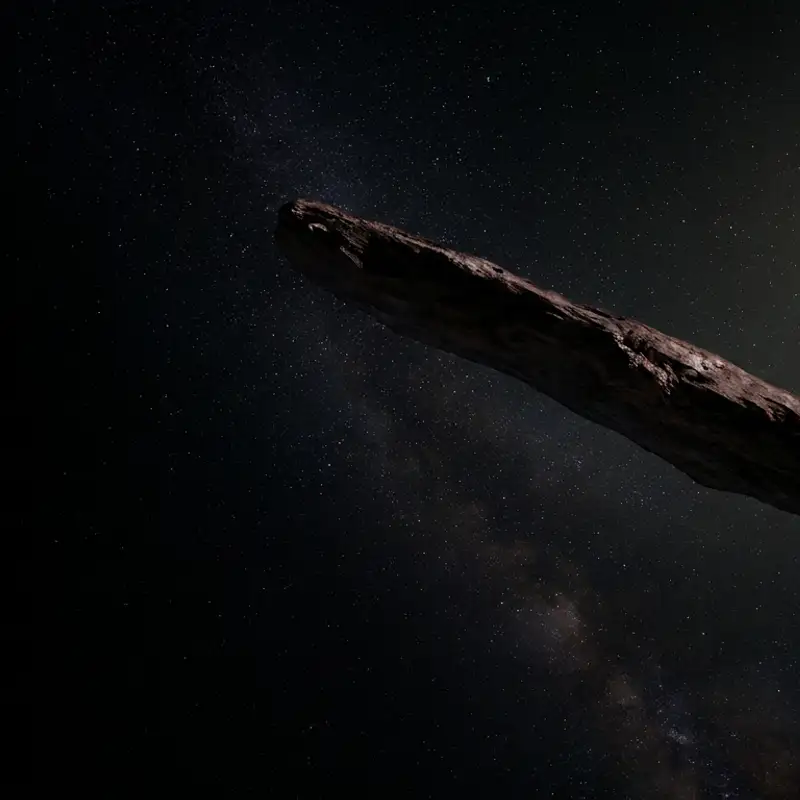
And then the idea of the cigar was
born.
Illustrations quickly spread around the world.
A dark red rocky cigar moving between stars.
There is just one important problem.
Nobody ever saw that cigar.
That matters.
The telescopes could not see ‘Oumuamua as a
detailed object.
It was too small and too far away.
It appeared as a point of light.
The shape was calculated from the changing brightness.
And the changing brightness can depend on several
things.
Shape, surface reflection, viewing angle, rotation.
Later studies showed that other shapes also could
explain the data.
Including shapes that were much flatter, something closer
to a disc or a pancake.
So whenever you see an image online with a
title like,
“This is what ‘Oumuamua looked like,”
you should mentally add a small note underneath:
artist's impression, because it is not a photograph.
Still, the extreme change in the brightness was
real.
And there is another interesting feature.
‘Oumuamua was not spinning in a simple, stable
way around one axis.
It was tumbling.
Imagine throwing a shoe, or a book,
through the air.
It can spin in more than one direction
at the same time.
Something similar can happen with ‘Oumuamua.
This kind of tumbling is known among asteroids
or other small objects.
It can be a sign of an earlier
collision, or perhaps another violent event in the
past.
And because there is very little in interstellar space
that can slow down the movement, a tumbling
motion can survive for a very long time.
The surface also happened to be interesting.
The color was reddish.
Not a bright metal structure, but not in
a way that clearly told us exactly that
what it was made of either.
Red surfaces are seen on several kinds of
small objects in our own Solar System.
They can be created by long-term exposure
to radiation and chemical changes.
So at this point, we have something strange,
but nothing impossible.
An interstellar visitor, a huge change in brightness,
an unusual shape, a tumbling rotation, a reddish
surface, and then we have something we're missing.
We have no clear tail, no obvious cloud
around the object.
In the first observations, it did not look
like a normal active comet.
It was interesting because ‘Oumuamua had just passed close
to the Sun.
If normal types of ice were exposed near
the surface, the Sun would have heated them.
That could have produced activity.
One of the early ideas was that the
surface may have been changed during its long
journey through interstellar space.
Maybe a layer of material had formed that
protected ice deeper inside.
Already, the simple picture was getting complicated.
Asteroid? Comet? Maybe neither word fit perfectly.
And that would make sense.
We created those categories by studying objects from
our own Solar System.
‘Oumuamua did not come from here.
Maybe the object did not fit our categories
because our categories were too small.
Then, almost a year after the discovery, researchers
published the result that changed the entire story,
the orbit.
If you look at the first cracks,
astronomy can sometimes be surprisingly simple.
You observe where something is, you wait,
you observe again, then you ask, does the
movement match the physics?
For ‘Oumuamua, astronomers had many accurate measurements of
its position.
Some came from observatories on Earth.
Others came from the Hubble Space Telescope.
Marco Micheli and his team analyzed those observations.
Their results were published in the journal Nature
in June 2018.
A model using only the expected gravitational forces
did not fit the observations perfectly.
But when the researchers added a small extra
acceleration away from the Sun, then the orbit
fit better.
This was not simply a weak, maybe-
there-is-something-here result.
The signal was statistically strong.
There really was a physical effect that needed
an explanation.
But there's an important phrase here, non-gravitational
acceleration.
It sounds mysterious, but it does not mean
unexplained.
It simply means a change in the motion
caused by something other than gravity.
And astronomers already knew a very common cause,
comets.
When the Sun heats a comet, ice can
turn directly into gas.
That gas escapes, often it carries dust with
it.
And as material leaves the surface, the nucleus
receives a small push
in the opposite direction.
So outgassing was the first obvious explanation.
In fact, Micheli and his team considered comet
-like outgassing to be a physically reasonable explanation
for the acceleration.
That is important.
The acceleration was not discovered as some impossible
mystery with no known natural process behind it.
The problem was more complicated than that.
If the gas was escaping, where was the
activity?
Researchers had looked for dust.
Deep observations did not show the obvious cloud
or tail normally associated with an active comet.
Other measurements also placed limits on certain gases.
So the simplest version, a normal comet doing
normal comet things, did not fit very well.
There could still be gas.
There could still be activity that was hard
to detect.
The chemical makeup might be unusual.
But now we were already building a
more special explanation.
Another challenge involved the rotation.
If gas is escaping strongly from a certain
area, from a small uneven object, that gas
should not only affect its path.
It should also be able to change its
rotation.
Think of it as a lawn sprinkler.
The water shooting out causes the sprinkler to
turn.
Astronomer Roman Rafikov argued that the amount of
outgassing needed to explain the acceleration should also
have a strong effect on ‘Oumuamua's spin.
That made the standard comet picture more difficult.
Not impossible, but difficult.
Now the list looks like this.
We have an interstellar object, extreme brightness changes,
tumbling, no obvious coma, and yet an extra
acceleration away from the Sun.
Each individual feature might have a natural explanation.
The interesting part is its combination.
And now we change the point
of view.
Because if you want to understand why some
people, including a very well-known Harvard astrophysicist,
start talking about technology, it's not enough to
say he thought it was aliens.
We need to follow the argument from the
inside all the way.
If we look at the alternative theory here,
the first point is that light can move things.
When we do not notice this in normal
life, because the pressure from the light is
incredibly small compared to the other forces around
us, but photons carry momentum.
When they hit the surface and it's absorbed
or reflected, they transfer a tiny amount of
that momentum.
In space, tiny forces matter.
There is no air resistance.
And if a force keeps acting long enough,
even a very weak acceleration can change the
object's speed.
That's the idea behind the solar sail.
Instead of carrying large amounts of fuel, a
spacecraft can open a very large and very
light surface.
Sunlight hits the sail and slowly the spacecraft
accelerates.
The closer to the Sun, the stronger the radiation
pressure is.
Farther away, the effects become weaker.
And this is not science fiction.
Humans have already tested solar sails in space.
And much more extreme light sails have been
proposed for future missions between the stars.
Avi Loeb himself has worked in this general
area through Breakthrough Starshot.
The basic idea of Starshot is to build
a very small, very light spacecraft with sails.
Powerful lasers would push those sails.
And in theory, the spacecraft would reach a
meaningful fraction of the speed of light.
So this was part of the background when
Shmuel Bialy and Avi Loeb looked at ‘Oumuamua’s
strange acceleration.
They asked a simple question.
What if the gas was not pushing it?
What if sunlight was?
If that were true, you could use the
measured acceleration and work backward.
How much mass would the object have compared
with the surface area catching the sunlight?
The answer was unusual.
If sunlight was responsible for the acceleration, ‘Oumuamua
would need a very low mass compared with
the surface area.
In other words, a lot of surface.
And very little mass.
If you imagine it as a solid sheet
made of normal materials, the required thickness could
be less than a millimeter.
So now we get a very different
picture.
Not the famous dark cigar.
A thin structure, large enough to catch sunlight.
Light enough for the tiny pressure of photons
to matter.
And suddenly, the changing brightness becomes interesting in
a different way.
As researchers continued studying the rotation, a long
cigar was no longer the only possible shape.
A much flatter object could also fit the
observations.
And a flat object naturally sounds more like
a sail than a giant rock shape like
a pencil.
That does not mean that an alien light
sail would have to be a perfect shiny circle.
An old technological object might be damaged.
Bent.
Broken.
Folded.
It could be a piece of something larger,
or a structure whose original purpose no longer
matters.
So the alternative idea does not have to
be there was an alien pilot inside ‘Oumuamua
holding a steering wheel.
In fact, the idea becomes more interesting when
we remove Hollywood from the story.
Instead, think about technology as archaeology.
understand this on Earth.
A civilization does not need to still exist
for us to discover it.
If archaeologists find a Roman sword, there does
not need to be a Roman soldier standing
next to it.
If we find an ancient stone tool, the
person who made it has been gone for
thousands of years.
Technology can survive its creators, sometimes for a
very long time.
In space, that time could be even longer.
There is no rain.
There is no forest growing over the object.
There is no normal weather.
There is no Earth-like atmosphere.
There are still dangers: radiation, tiny impacts, heat
and cold, and collisions.
But an object can in principle survive and
drift for an extremely long time.
So imagine a technological civilization around another star.
Maybe it existed a million years ago, maybe
100 million years ago.
It sent objects into space, probes, sails, scientific
instruments, communication devices, maybe millions of small and
cheap machines.
Eventually the civilization disappeared.
The planet changed.
Maybe the entire species went extinct.
But some of the objects kept moving.
That is one way to understand Loeb's idea
of space archaeology.
We may not have to wait for somebody
to say hello on the radio.
We might be able to find their objects.
And if we do, the first thing
we find may not be a perfect working
spacecraft.
It might be debris, a dead probe, a
broken sail, a machine that has stopped working
a million years ago.
It could simply be technological driftwood.
That idea matters because it changes several questions
people often ask.
Why didn't ‘Oumuamua send us a message?
A dead object does not need to.
Why didn't it fly toward Earth?
A drifting object does not need to.
Why didn't it slow down?
A passive sail does not need to.
Why didn't it contact us?
Maybe contact was never its purpose.
And why would anyone send objects through the
empty space between stars anyway?
Here we can turn the question toward ourselves.
We are already doing something similar.
Voyager 1 and Voyager 2 are leaving our
planetary system.
The Pioneer spacecraft are also moving outward.
They were not sent to visit alien civilizations.
But if they survive long enough, they will
become human-made interstellar objects, tiny pieces of
our civilization moving through the galaxy.
And we have only been a space-
faring civilization for a very short time.
Imagine a civilization that has had space technology for
100,000 years or a million years.
The amount of material that it could produce
might be enormous.
And if some civilizations learned to build small
probes cheaply, the galaxy could contain technological objects
without being filled with giant starships.
This connects to an old question, the Fermi
paradox.
If there were many places in the galaxy
where life could develop, and the Milky Way
is billions of years old, where is everybody?
Why don't we see the obvious signs?
One possible answer is that nobody else is
there.
Maybe technological intelligence is extremely rare.
Another possibility is that civilizations do not last
very long.
Another is that the distances are simply too
great.
Another possibility is that we are looking in
the wrong way.
Traditional SETI has focused a lot on communication,
radio signals, laser pulses, and other signs of
technology.
But communication depends on timing.
If a civilization sent a signal through our
part of the galaxy a million years ago,
that does not help us today.
A physical object can be more patient.
It can drift.
It can wait.
It can survive its creators.
So from that point of view, interstellar space
is not only empty space.
It could also be an archaeological landscape.
And then ‘Oumuamua arrives, the first object we
know for sure came from that space.
It did not immediately look like the type
of comet many people expected.
Its brightness changed dramatically.
It did not have any obvious comet tail.
It had an extra acceleration, and perhaps it
had a very flat shape.
From inside this technological interpretation, the main point
is not a single smoking gun.
It's the combination.
The first known interstellar object had several features
that did not immediately look normal compared with
the small objects we knew from our own
Solar System.
One possible physical explanation for the acceleration required
something very light.
That creates a question we can ask without
even using the word alien.
Do natural objects exist with the right surface
area to mass ratio?
If the answer is yes, then we have
a natural candidate.
If the answer is no, then what is
a structure like that doing in space?
And there are more details.
One is ‘Oumuamua's speed before it entered the
Solar System.
The stars around us do not all move at
exactly the same speed and direction.
But astronomers describe an average local
movement called the local standard of rest.
You can think of it as a kind
of an average traffic flow in our part
of the galaxy.
‘Oumuamua had a relatively low speed compared with that
frame.
Loeb has pointed this out as an interesting
detail.
You can imagine an object that is almost
waiting in this galactic traffic frame.
It does not have to chase individual star
systems.
The stars came to it.
Imagine a buoy floating in the ocean.
The buoy does not have to travel to
every ship.
The ships pass the buoy.
In the same way, technological objects could in
theory exist in interstellar space as markers, relay
points, or probes.
the Sun might be the moving part of
the meeting.
Our entire Solar System travels through the galaxy.
And during that journey, it could pass an
object.
That is a much quieter idea than
an invasion.
And because of that, it also cannot
be dismissed by simply asking: if it was
technology, why did it not do anything?
Maybe doing nothing was exactly the point, or
maybe it was no longer working at all.
Then there is the question of survival.
Could an extremely thin structure really travel between
the stars without being destroyed?
Bialy and Loeb studied the effects of interstellar
material and other physical stresses.
Their conclusion was that a thin structure made
from strong enough material could, in principle, survive
travel over large interstellar distances.
That does not prove ‘Oumuamua was such a
structure, but it removed one easy objection.
You cannot simply say something that thin could
never survive.
You have to calculate it.
And that brings us up to something that
probably helped explain why Loeb's argument became so
popular outside astronomy.
He also challenged a cultural attitude inside science.
His view is that artificial origin should be
allowed on the list of possible explanations if
the data points toward conditions that technology
could explain.
Not because technology should be the default answer,
but because the question should not be banned
before the evidence is examined.
If an object behaves in a way that
reminds us of something we could build ourselves,
why should we refuse to study that possibility?
Loeb often uses simple comparisons.
Imagine walking along a beach and finding a
plastic bottle.
If you had never seen technology before, maybe
you will first try to explain it as
a strange rock.
But at some point, the
shape and the structure would become so specific
that construction would make more sense than geology.
The difficult question is, when do we reach
that point?
How strange does something need to be?
That is the whole fight over ‘Oumuamua in
miniature.
Someone who supports the technological hypothesis sees several
unusual features that may point in the same
direction.
The missing comet tail, the acceleration, the brightness
changes, the possible flat shape, the low
mass compared with the surface area if sunlight
caused the acceleration, the interstellar path, and the
unusual speed compared with the local galactic frame.
Seen from that point of view, the question
becomes, how many unusual features does an object
need before the idea of something manufactured is
allowed on the board?
There is also the issue of numbers.
Before 2017, we had never discovered an interstellar object.
So how many did we expect there to
be?
If ‘Oumuamua represents a natural population of small
objects, there must be enough of them in
space for Pan-STARRS to have a
realistic chance of finding one.
The discovery itself changes our estimate of how
common these objects might be.
With technology, we have an even bigger unknown.
We have zero confirmed examples of alien artifacts.
So we cannot simply open a textbook and
look up the correct probability.
Imagine a civilization sending out one probe.
That would create almost no objects.
Imagine a civilization producing trillions of small sails
over a million years.
That calculation completely changes.
We do not know which kind of universe
we live in.
And supporters of the technological idea would say
that we should be careful about declaring it
impossible based on intuition.
Then there is the lack of a radio
signal.
Researchers did search ‘Oumuamua for artificial
radio emissions. They did not find a convincing
transmission.
But again, if we stay inside the technological
interpretation, that does not automatically settle the question.
A sail does not need to transmit.
A broken piece of technology does not need
to transmit.
A million-year-old probe with dead electronics
board does not need to transmit.
Human-made objects do not automatically broadcast
an easy-to-detect radio signal forever either.
So if we want to test a technological
hypothesis properly, we need something more.
A picture, a sample, a close flyby, a
measurement of the object's mass, better spectroscopy,
a direct measurement of any gas leaving the
surface, maybe radar under the right conditions with
another future object.
And that leads to what we call maybe
the strongest point in the entire alternative story.
Next time, we need to be ready because
‘Oumuamua was discovered too late.
It came in, it passed the Sun, and
only then did we see it.
If a spacecraft had already been ready to
go, the story might be very different.
Imagine sending a camera.
Then we would not need to argue about
artistic pictures of cigars and pancakes and so on.
and so on.
We might have a real photograph.
Imagine a rough natural object, rock, cracks, ice,
a strange geological surface.
That would have greatly weakened the technological idea.
Now imagine instead seeing a thin membrane with
regular structures.
Then we would have a very different conversation.
The wonderful thing is that these
two possibilities do not
require two different philosophies.
They need the same instrument, a camera.
That is where the alternative theory becomes the
most interesting, not as a belief, but as
an argument for collecting the kind of data
that could destroy the theory or make it
much stronger.
In that sense, ‘Oumuamua might be more important
as a warning than as an
answer.
We were not ready.
An object from another star passed through our
planetary system.
We discovered it, but we discovered it just
late enough that we could not
take a closer look.
If it was a rock, we missed the
chance to photograph material from another planetary system
at close range.
If it was technology, we missed the chance
to inspect what would have been the most
important archaeological discovery in human history.
And now it is gone, not mysteriously disappeared, just
continuing on its path out of the solar
system while we stay behind, arguing about what
we saw.
If you go down the rabbit hole, then
in August 2019, something happened that might have
made ‘Oumuamua seem less special.
An amateur astronomer named Gennady Borisov discovered another
object on a hyperbolic path.
It became 2I/Borisov, the second known
interstellar visitor.
And this time the picture looked much more
familiar.
Borisov was clearly a comet.
There was activity: gas, dust, a visible coma.
It fits naturally with the idea that planetary
systems create huge numbers of small objects and
throw some of them out into interstellar
space.
So you could say, fine, now we know
interstellar objects are comets.
‘Oumuamua was just an unusual one.
But one discovery cannot tell us that.
Borisov shows us that other planetary systems produce
comets that can reach us.
It does not automatically tell us what ‘Oumuamua
was.
In fact, the comparison makes ‘Oumuamua's missing obvious
coma stand out even more.
And then something else happened.
On July 1st, 2025, a third interstellar object
was reported.
It became 3I/ATLAS.
It also showed clear comet activity.
So now in 2026, we have three confirmed
interstellar visitors.
‘Oumuamua, Borisov, and 3I/ATLAS.
Numbers two and three look broadly like comets.
Number one is still the strange member of the
family.
That is both important and dangerous.
Important because we're finally getting something to compare with.
Dangerous because three objects are still almost nothing
statistically.
Three objects cannot tell us what the full
population of interstellar bodies looks like.
But they do tell us one important thing.
These visitors are real.
Interstellar objects do pass through our Solar System.
This is no longer only a theoretical idea.
And if we can discover them earlier, maybe
one day we can visit one.
That brings us to Project Lyra.
Soon after ‘Oumuamua was discovered, researchers and engineers
began asking whether a spacecraft could ever catch
it.
The challenge is huge.
‘Oumuamua already had a major head start.
It is leaving the Solar System quickly.
If we start chasing years later, the spacecraft
would first need to cover all the distance
the object has already traveled.
Then it still has to catch it.
So it has to move faster.
Different mission ideas have been studied.
Gravity assists, flybys of Jupiter, extreme paths near
the Sun.
Other ideas try to avoid the most difficult
close paths near the Sun.
A published Project Lyra study has shown that
at least one possible mission path using technology
based on known spacecraft methods. The trip would
still take decades.
That does not mean a mission has been
approved.
There is no spacecraft sitting on a launch
pad waiting to chase ‘Oumuamua.
Project Lyra is a mission study.
But the fact that people can seriously calculate
a possible intercept is fascinating.
Imagine that mission.
We launch a spacecraft.
It travels for decades.
the Sun becomes smaller and smaller behind it.
Eventually, the spacecraft reaches a region where almost
everything made by humans is unbelievably far from
home.
And somewhere out there, it has to find an object
that we first saw as a tiny point
of light in 2017.
If we ever received a close-up photograph
of ‘Oumuamua after decades of chasing it, the
results would be historic almost no matter what
it showed.
A chunk of ice would be historic.
A fragment of another planet would be historic.
An extremely light natural structure would be historic.
Technology would obviously be something else entirely.
But there is another important point.
‘Oumuamua has already changed the way people think
about interstellar objects.
It turned them into possible mission targets.
And in that sense, Loeb's idea of space
archaeology grows beyond the one object.
If alien technological artifacts exist, we may not
only need to search hundreds of light years
away.
Some could pass through our own neighborhood.
Some might already be somewhere in our solar
system.
Some could even hit Earth.
The idea later led Loeb toward the
search for possible interstellar meteors and material recovered
from the ocean floor.
That story needs its own careful investigation.
And the evidence there has to be judged
separately.
But the basic idea comes from the same
question.
What if SETI is not only about listening?
What if someday we can actually pick something
up?
There is something strange about the idea.
The classic picture of contact with
alien intelligence is a message, a signal through
a radio telescope, numbers, mathematics, a greeting.
But the first real sign of another
technology might be much less poetic, a piece
of trash, a broken machine, a dead probe,
something that has lost its purpose a long
long ago and is simply drifting, and maybe
we never meet the beings who built it,
that could almost be more unsettling than a
living spaceship.
We might find proof that we are not
the first technological species, and still we will
be completely alone.
But before we go too far into that
darkness, we need to come back to ‘Oumuamua.
Because so far we have allowed the technological
explanation to stand in its strongest form.
Now we need to ask the same kind
of hard questions about it, that it asks
about the traditional explanations.
What survives? What is assumed? And are there
natural models that actually explain the observations better?
If we go to the criticism, then I
think we should start with the most important
fact.
Nobody observed technology on ‘Oumuamua.
That is a simple sentence, but it also
clears away a lot of confusion.
We do not have a photograph of a metal
sheet.
We do not see wires, solar panels, bolts,
engines, an antenna, regular manufactured patterns.
We did not detect an artificial radio signal.
We did not observe a controlled intelligent maneuver.
So the technological idea is based on indirect
clues.
That is not automatically a problem.
A lot of science is based on indirect
evidence.
But then we have to ask, is technology
actually required to explain the observations?
Right now the answer is no.
But let's go through the main points.
First, the shape.
‘Oumuamua was very uneven or stretched out
in some way.
That is strongly supported by the changing brightness.
But the cigar shape was never seen.
It was calculated.
Later studies showed a flatter shape would also
fit the data.
So both the famous cigar and the famous
solar sail are pictures that we have placed
on top of brightness measurements.
What we actually observed was a light
curve.
When we say it is very flat, we
have already chosen a model.
Then there is the missing tail.
That's also real.
Deep observations did not find any normal dust
activity.
But there is an important difference between the
two statements.
No visible tail and no outgassing at all.
That is not the same thing.
Gas can be difficult to detect.
Different molecules produce different signals.
Dust production can be low.
The surface might be different from the comets
we normally study.
Even in 2017, researchers were considering whether ice
could survive deeper inside ‘Oumuamua underneath a
surface changed by its long journey
through interstellar space.
So saying it did not look like a
normal comet does not automatically mean that there
could not be ice.
There is also a deeper problem with our
expectations.
‘Oumuamua was the first object of its
kind we had ever seen.
It may be risky to define normal by
looking only at objects formed in our
own Solar System and then expecting everything from
other systems to look the same.
Exoplanets have already taught astronomers this lesson.
When the first planets were discovered around the
stars, some of them were not what scientists
expected.
Hot Jupiters, giant gas planets extremely close to
their stars, were not something our own Solar
System had prepared us for.
Nature had more designs than our local example
suggested.
The same could be true for small objects.
Then there is the acceleration.
That may be the single most important feature
of the whole debate.
But again, non-gravitational acceleration does not mean
technological acceleration.
Comets experience it.
And the original Nature study that measured the
extra acceleration considered comet-like outgassing to
be the most reasonable physical explanation among the
mechanisms the researchers examined.
So why didn't the story end there?
Because we were missing the obvious gas and
dust activity.
That pushes researchers toward more unusual natural models.
One of them involves tidal breakup.
In 2020, Yun Zhang and Douglas Lin modeled what could
happen if a larger object passed extremely close
to its star.
Strong tidal forces could tear the object apart.
The material could be heated.
The fragments could develop extreme shapes.
And some of those fragments could later
be thrown completely out of the planetary system.
In that model, ‘Oumuamua would be unusual because
it went through an unusually violent natural event.
Not because somebody built it.
This is important because extreme objects can
come from extreme natural histories.
A rock that spent billions of years quietly
orbiting in an asteroid belt is one thing.
A fragment that was torn from a larger
body during a close encounter with a star
is something completely different.
Then there is nitrogen.
In 2021, Alan Jackson and Steven Desch proposed
‘Oumuamua might be a piece of solid nitrogen
ice from the surface of a Pluto-like
world.
We know Pluto itself has huge areas
of nitrogen ice.
So the material is not imaginary.
Imagine a young planetary system around another star.
Large impacts strike the surface of the Pluto
-like world.
Pieces of nitrogen ice are thrown free.
The movement of the planets and other
bodies throw some of them completely out of
the system.
One fragment travels through interstellar space for millions
or billions of years.
Eventually, it enters our Solar System.
As it approaches the Sun, the nitrogen turns
into gas.
That could create the extra acceleration.
At the same time, the properties of nitrogen
ice could help explain why astronomers did not
detect the specific gases and dust.
They expected from a more normal comet.
It is an interesting model because it makes
‘Oumuamua almost as exotic as the technological idea, but
without a civilization.
It could be a physical piece of the
surface of a Pluto-like planet around another
star.
If that were true, a piece of another
world just flew past us.
You almost do not need aliens to make
the story incredible.
But the nitrogen model has also faced criticism.
One question is whether enough nitrogen ice fragments
could realistically be created, survive, and be thrown into
interstellar space for us to have already discovered
one.
Jackson and Desch have tried to address those
population questions.
So the debate is not only about whether
one nitrogen fragment could behave like ‘Oumuamua.
It is also about whether the universe could make
enough of them.
Then there is hydrogen.
And here we need to separate two different
ideas.
One early proposal involved objects almost entirely from
solid molecular hydrogen.
That idea faced major problems with how such
objects could form and survive.
But in 2023, Jennifer Bergner and Darryl Seligman
proposed something different.
‘Oumuamua would not need to be made of
hydrogen.
It could mainly contain water ice. During a
long journey through interstellar space,
cosmic radiation hits the ice.
That radiation could change the molecules and create
molecular hydrogen or H2 inside the ice.
Some of that hydrogen could become trapped.
Then ‘Oumuamua enters our Solar System. the Sun
heats it, the structure of the ice changes, and
the trapped hydrogen escapes.
That escaping hydrogen produces
a push.
It is an elegant possible answer to one
very difficult problem: acceleration without a normal dusty
tail.
If the model is right, ‘Oumuamua would be
a fairly ordinary ice-rich object that
was simply changed by spending a very long
time between the stars.
But science did not stop here either.
Later that same year, Niels Ligterink challenged the model
in Nature.
He argued that the proposed process might not
produce enough hydrogen under the necessary conditions.
Bergner and Seligman responded, and that is a
good example of something that also disappears from
many popular stories about science.
A paper does not always solve a mystery.
A paper proposes a model. Other scientists read
it, do their own calculations, and
find possible problems.
The original researchers respond, new data appears, and
maybe years later, one explanation survives better than
the others.
So whenever you see a headline saying that
‘Oumuamua mystery finally solved, check the date.
It may be a Tuesday solution.
By Thursday, another paper may be arguing with it.
It does not mean that every idea is
equally good.
It means that we need to separate a
promising model from an established fact.
Now let's get back to the light sail.
The interesting result from Bialy and Loeb is
physical.
If sunlight pressure causes the acceleration, then the
object needs a very low mass compared with
its surface area.
That tells us something about what such an
object would have to be like.
But there is a jump between the two
statements.
Statement one, a very thin or very light
object could be accelerated by sunlight in this
way.
Statement two, therefore, ‘Oumuamua was an artificial light
sail.
Statement two does not automatically follow from statement one.
Before we can jump to that, we need
to rule out natural objects with similar physical
properties.
Researchers have also looked at very light,
fluffy structures.
Extremely loose collections of dust could have large
surface areas compared with their mass.
Think less solid rock, and more cosmic cotton candy.
Those ideas also have problems.
Can such structures form?
Can they survive?
Can they pass close to the Sun
without falling apart?
But the most important point is this: just because a
property reminds us of technology, does not mean
technology is the only way to create that
property.
Next criticism is about probability.
This part is a little abstract, but stay
with me.
Imagine two explanations.
Explanation A: a natural interstellar object with properties we
do not completely understand.
Explanation B, a technological artifact made by an
alien civilization.
Both might be made to fit some of
the observations, but should they start with the
same probability?
Many scientists would say no.
They would begin with A. Not because
B is forbidden, but because we already know
natural small objects exist.
We know planetary systems produce them.
We have observed huge numbers of asteroids and
comets.
And since ‘Oumuamua, we have
found two more interstellar objects that clearly look
like comets.
On the other hand, we still have
no widely accepted direct detection of alien technology.
So the two ideas do not necessarily begin
at the same starting line.
This is basically a Bayesian question.
An unusual explanation can absolutely be correct, but
the evidence has to be strong enough to
move us away from a lower starting probability.
If I hear hoofbeats outside a house in
the United States, I will probably think of
a horse before I think of a zebra.
Not because zebras are imaginary, but because I
know something about where I am.
On the African savannah, the probability would be
different.
The problem with interstellar objects is that we
still barely know which kind of a zoo
we are standing in.
We have three.
Three. That is all.
We do not have thousands of examples.
So some features that look extremely strange
compared with objects in our own Solar System
might turn out to be normal among interstellar
objects, or they might be truly rare.
We just do not know yet.
This also affects lists of anomalies.
Suppose somebody says feature A is very unlikely,
feature B is very unlikely, feature C is
very unlikely, feature D is very unlikely.
Then they multiply those probabilities together and get
an unbelievably tiny number.
That only works if those features are independent.
If the same natural process creates the shape,
the rotation, and the acceleration, then those are
not necessarily separate accidents.
A violent close encounter with a star could
affect both shape and surface.
The chemical composition could affect both outgassing and
brightness.
The formation history could also affect rotation.
The unusual features can be connected.
Then there's also another problem with the technological
hypothesis.
It can become extremely flexible.
If the object is long,
technology can be long.
If it is flat, a sail is flat.
If there is no radio signal, it is dead.
If there is a radio signal, it
is active.
If it moves toward Earth,
It's a probe.
If it does not, it is debris.
If it tumbles, it is damaged.
If it rotates perfectly,
It is designed that way.
A theory that can explain every possible
result after the fact becomes too hard
to test.
Science works best when a theory makes predictions
that can fail.
If we can observe one thing, the theory
should become much stronger.
If we observe something else, it will become
weaker.
And that is why the next interstellar object may ultimately
matter more than every argument about ‘Oumuamua.
We cannot take new measurements of ‘Oumuamua now,
but next time we can decide in advance
which observation would be truly unusual under natural
explanations.
What would a technological object predict?
Can we measure its mass?
Can we photograph the surface?
Can we identify gases?
Can we measure the acceleration and the outgassing
at the same time?
Can we send a spacecraft past it?
That is how the idea becomes testable.
And now we are ready to clear the
table. Not spaceship or rock, but point by
point what we actually know.
So what actually holds up?
Let's begin with what is solid.
‘Oumuamua came from interstellar space. That is well
established.
Its orbit was hyperbolic and was not bound
to the Sun.
There's no serious debate about the fact that
it was a visitor from outside our Solar
system.
That alone was historic.
We also know that the brightness changed dramatically.
That is documented.
It means the visible area or reflective properties
changed strongly as the object rotated.
A very uneven shape is a reasonable
conclusion.
But the exact shape is not known.
The cigar is a model.
The pancake is a model.
The solar sail is a model.
We do not have a direct image that
shows the shape.
We know the object was tumbling.
Several studies of the light curve support a
complex rotation.
It is not itself evidence for technology.
A violent natural history could easily produce tumbling.
We know astronomers did not observe a normal
obvious coma or a dust tail.
That is also documented.
It makes ‘Oumuamua unusual compared with classic active
comets.
But it does not prove there was absolutely
no outgassing.
We also know the object experienced a small
extra acceleration.
That is one of the strongest results in
the whole story.
And here the language matters.
The acceleration is not speculation.
The cause of the acceleration
is.
It could have involved outgassing.
It may have involved one of the more specific
natural processes we have discussed.
If the object had the right surface-area-
to-mass ratio, sunlight pressure could also produce
an effect.
But we did not directly measure the
surface-area-to-mass ratio.
And this is where the interpretation begins.
Then we have what is most likely.
one.
Based on the evidence available today, a natural
object is the most cautious and most widely
accepted explanation.
That does not necessarily mean an ordinary
comet exactly like one from our own
Solar System.
‘Oumuamua could be the product of environments and
processes we have never had the chance to
study up close before.
That may be exactly why it looked so
strange.
Then we have what remains uncertain.
Which natural process best explains the acceleration, shape,
and lack of obvious activity together.
There is no single final model that gives
us a photograph of ‘Oumuamua with the answers
written underneath.
The nitrogen ice idea is one possibility.
Hydrogen released from radiation-processed water ice is another.
More normal forms of comet-like activity
are still discussed.
Tidal breakup may help explain an
extreme history and unusual shape.
And finally, we have what is speculative.
An artificial light sail, a probe, a navigation
buoy, technological debris, a piece of a larger
alien structure.
There is no direct evidence for any of
those things.
That does not mean logically impossible.
It means we do not have the observation
needed to move from possibility to discovery.
And that is where the difference really lies
in this story.
The exciting thing about ‘Oumuamua does not have to
be that we discovered aliens.
It may be that for the first time
we saw material from another star system passing
through our own system and realized how little
experience we have with these objects.
So what was ‘Oumuamua?
If I had to choose based on the
evidence we have, I would begin with a
natural explanation.
That is where the total evidence points most
strongly.
But I would be careful with the next
sentence, because natural does not necessarily mean ordinary.
Almost the opposite.
‘Oumuamua could have been part of a
type of world we have never visited.
A fragment created during a violent encounter near
another star.
A strange type of icy body, an object
changed by millions of years in interstellar space.
If even one of those ideas turns out
to be right, the story would still be
incredible.
And the technological possibility? It has not been
demonstrated.
We do not have a technological signature, no
direct observation of a manufactured structure, no confirmed transmitter,
no maneuver that requires intelligence.
So we cannot simply jump from strange to
manufactured.
But one part of the challenge should remain.
If we ever find an object that is
really artificial, we need to have the science
capable of recognizing it.
Not a science that automatically says aliens, but
also not a science that has already decided
that the answer can never be technology.
The real solution is almost annoyingly boring.
We need better data.
And fortunately, we are already in a better
position than we were in 2017.
We know interstellar objects pass through our Solar
system.
We have seen ‘Oumuamua, Borisov, and 3I/ATLAS,
and future sky surveys will find more.
So the next time a truly strange object
arrives, we know which mistakes we do not
have to repeat.
Find it early, measure it quickly, follow the
acceleration, look for gas, determine the rotation, and
if we can, send something after it.
Because one day the answer could be almost
anything.
A comet from another star, a fragment of
an exoplanet, a kind of material that we
have never held in our hands, or something
far less likely.
‘Oumuamua did not give us the answer to
whether we are alone.
It gave us something more modest and maybe
something more useful.
A warning that the next time the question
passes through our neighborhood, we may not have
very long to ask it.
Thank you for listening.
01:07:59,880 --> 01:07:59,980