
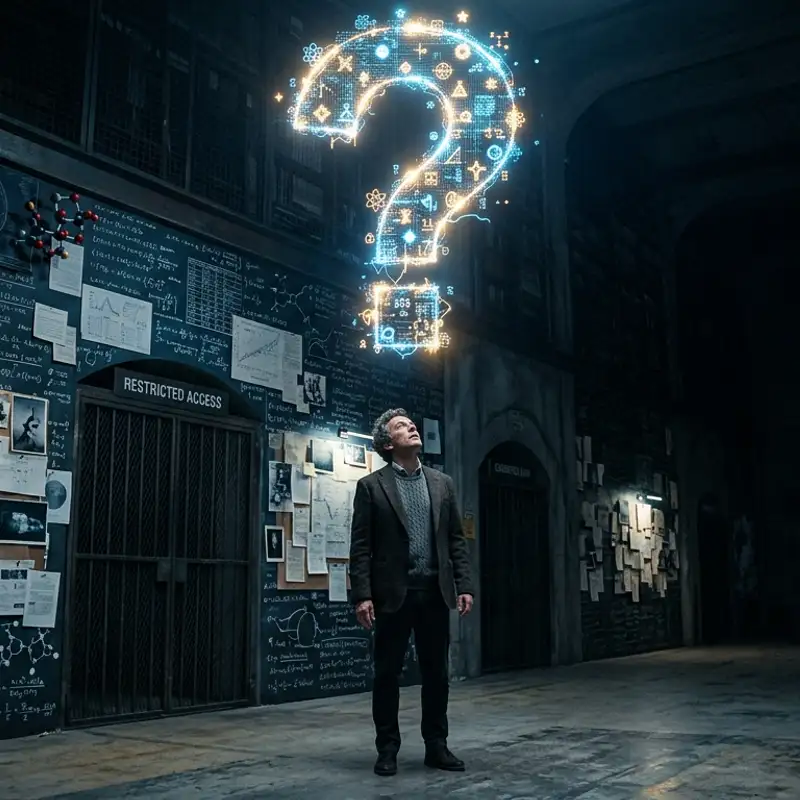
Science versus truth. Why falsification is dead in practice? Science is supposed to be falsifiable. That's not optional. That's the foundation.
René V. Nielsen:But today, we ask a hard question.
Narrator:What happens when science can no longer be tested by anyone outside the institution?
René V. Nielsen:Because a claim that cannot be challenged is not science, it's doctrine. Philosopher Karl Popper argued that science advances by being wrong. A theory must expose itself to failure.
René V. Nielsen:If nothing can disprove it, it explains everything, and therefore nothing. This principle won't separate science from ideology, but it depends on openness, and openness is disappearing. Today's science is trend driven, deadline driven, reputation driven. Researchers are awarded for publishing often alignment with existing frameworks and avoiding controversy. Disproving a dominant model does not get funded.
René V. Nielsen:Refining it does. This ain't corruption, that's intensiveness, and intensiveness shapes the outcome. In the last decade, large scale replication efforts revealed something alarming. A significant portion of published findings could not be reproduced, especially in areas like psychology, medicine, social science. Yet most of these findings remain cited.
René V. Nielsen:Why? Because the system values publication, not correction. A theory can survive failed replication as long as no one has the power or incentive to kill it. Many modern claims rely on proprietary models, closed data set, classified inputs, and especially in areas like climate, modeling, epidemiology, defense, science, aerospace, surveillance. If you cannot access the data, you cannot falsify the claim.
René V. Nielsen:You can only defer, and deferral is not science. When valsification fails, consensus fills the gap. Arguments like expert agrees, but agreements is not evidence. As Kuhn shown, consensus often reflects social alignment, institutional stability, and risk avoidance. But history shows this repeatedly.
René V. Nielsen:Ulcers were stress related until bacteria. Continents didn't move until the theory of plate tectonics. Pilots did not see UFOs until they did. Consensus only delays truth. Take the Black Knight satellite.
René V. Nielsen:The explanation about space debris might be correct, but because of tracking data is classified, internal analysis is not public, verification is impossible, it is administratively true, it is not scientifically fortified, and that distinction matters, because it's supplies everywhere. When science cannot be tested, it becomes enforced by authority. This is not anti science, to say it's pro science, because science, without doubt, is theorology. Valsification is not dead in textbooks, it's dead in practice. Every time we accept a claim, we cannot examine.
René V. Nielsen:The future of science does not depend on the smarter models. It depends on courage to release data, to admit uncertainty, and to accept being wrong. Without that, the truth is not even close to evidence, but it is to power. Thank you for listening.