
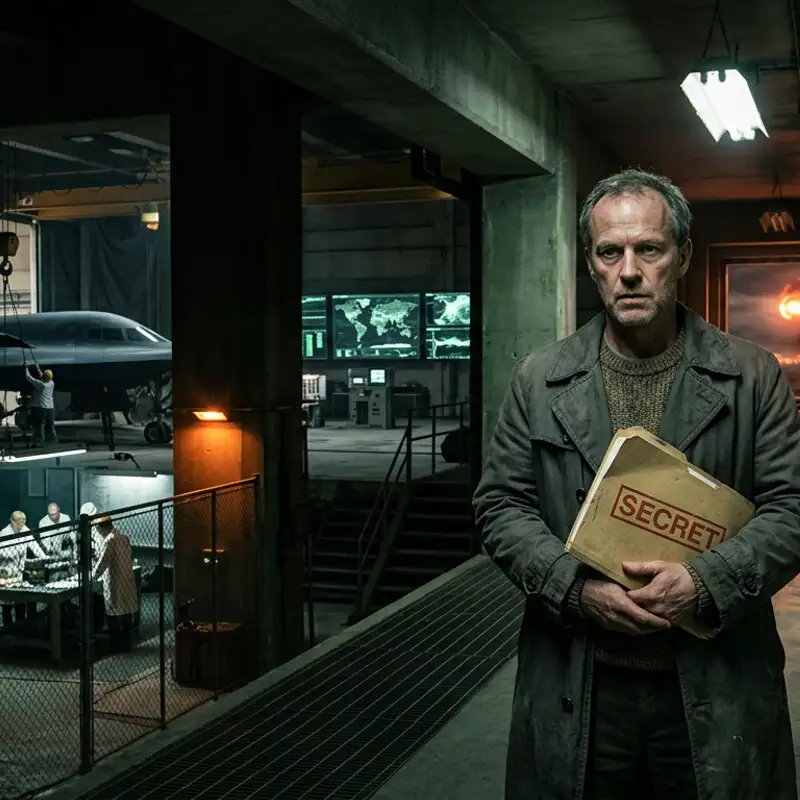
The Manhattan Project and the myth that big secrets can't be kept. There's one argument that comes up every single time secret projects are discussed.
Narrator:This cannot be true. Something that big can't be kept secret to many people would have known.
René V. Nielsen:It sounds reasonable. It sounds logical, and it's false. Today, we are going to talk about the Manhattan Project, the development of the atomic bomb during the Second World War, and what that project proved beyond any doubt, that governments can't carry out massive world changing projects in near total secrecy. For years, with tens of thousands of people involved. And then we followed the pattern forward from the Second World War to present day through other military intelligence programs that were officially denied, tightly controlled, and later confirmed.
René V. Nielsen:The conclusion is uncomfortable, but unavoidable. The Manhattan Project was not a small research effort. It was the largest scientific and engineering project in the world at that time. It was spread across multiple U. S.
René V. Nielsen:States. It was involving more than 130,000 peoples, costing roughly $2,000,000,000 in $19.40 dollars in today's money, hundreds of billions. Entire cities were built from scratch, new industries were invented, materials never handled at scale before it was processed daily, and yet the American public had no idea what was being built. Congress has only fragmentary awareness. Even vice president Truman did not know the full scope until shortly before becoming president.
René V. Nielsen:It was not an accidental secret. It was engineered. The Manhattan Project succeeded because of secrecy, not despite of it. The secrecy rested on several principles that remain today. First, extreme compartmentalization.
René V. Nielsen:Most workers only knew their immediate task, their specific tools or process, nothing about the final goal. A machinist works on components, a chemist works on isotope separation, an engineer worked on cooling system. Very few people saw the entire picture. The second principle, possible cover stories. Facilities like Los Alamos, Oak Ridge, and Hanford were presented as routine military installations, industrial research sites, wartime manufacturing centers.
René V. Nielsen:During World War, people didn't ask too many questions. They were told that they were helping the war effort, and that was enough. The last thing was the social administrative control. Meals were monitored, phone calls were restricted, travel was locked, not for terror, but for bureaucracy. And most importantly, people do not know they were holding a secret worth leaking.
René V. Nielsen:The secret held completely until August. When the bomb was dropped on Hiroshima, the truth was revealed instantly and irreversibly, not through leaks, not through investigating investigative journalism, not through whistleblowers, but when the government choose to reveal it. This matters because it destroys a common assumption.
Narrator:The absence of a deed is not evidence that a secret does not exist.
René V. Nielsen:In fact, it may be the evidence that secrecy is working exactly as intended. The Manhattan Project wasn't an anomaly it became a template. Let's look at a few examples. Look at the F-one 117 Nighthawk, America's first operational stealth aircraft flew for years in secret. Thousands of engineers, technicians, pilots, ground personnel and contractors were involved.
René V. Nielsen:The aircraft existed. It flew, it trained, and officially, it did not exist until 1988. Second example, MKUltra, a CIA program involving human experimentation, psychological manipulation, LSD, and other substances officially denied for years, data confirmed through declassified documents. Thousands were involved across institutions, and the public knew nothing. The mass civilians.
René V. Nielsen:For years, U. S. Officials stated that domestic mass surveillance programs did not exist. They did. Only external disclosure made that undeniable when it was Snowden made his publication.
René V. Nielsen:Area fifty one, a facility that did not exist until it suddenly did. Decades of denial, decades of silence, tens of thousands of workers. People often say, if that many people were involved, something, someone would have talked. That assumes something crucial and wrong. It's assumed that people leak secrets because they know what they are part of.
René V. Nielsen:In reality, secret leaks when people understand the full picture, experience moral conflicts, and have a platform to be heard. Most secret projects are designed to eliminate all these three conditions. Compartmentalization does not just protect information, it prevents awareness. Today, often hear arguments like, This could not be hidden. That would be evidence.
René V. Nielsen:Too many people would have known. Historically, directly contradict is: We know we do not speculate, we know this. Governments can hide massive projects, tens of thousands can work without understanding the old picture, and truth often emerges only when classification ends. Secret is not an exception to modern states, it's a capacity. This episode is not saying that everything is a secret.
René V. Nielsen:It is saying that the argument that something can't be secret is historically false. We know that large, complex, world altering projects have been hidden before. So dismissing modern questions with that would be impossible to keep secrets is not skepticism, it's denial. If we want to understand the world honestly, we need to have two, we need to hold two truths at once. One, not every secret project is malicious.
René V. Nielsen:Two, governments do have the ability to keep enormous secrets. Only by accepting we can this, we can ask the serious questions without paranoia, but without blind trust. The Manhattan Project isn't just history, it's proof. Thank you for listening.