
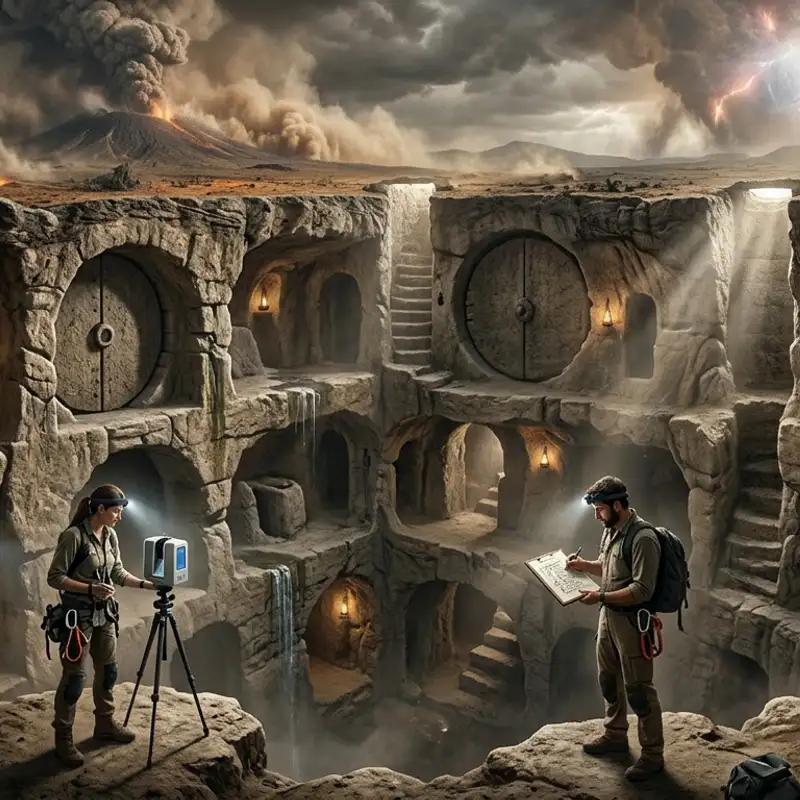
Underground civilizations, why humanity built downward and why history overlooked them?
René V. Nielsen:When we think about civilizations, we almost always think upward, temples, pyramids, walls, cities rising towards the sky. But archaeology repeats showing us something else.
René V. Nielsen:Societies that invested enormous resources in building underground. It's not through caves, not emergency shelters, but complex long term systems designed to function for months, years, possibly generations.
René V. Nielsen:The question isn't many of these places exist.
Narrator:The question is why would entire societies build cities no one was meant to see?
René V. Nielsen:If you look into Turkey, in the Central Turkey, the region of Cappadocia contains the most densest known network of underground cities on Earth.
René V. Nielsen:Cities such as Derinkuyu and Kaymaklı descend more than 250 feet down, spawned up to 18 levels, and could sustain tens of thousands of people, along with animals, food storage, and social institutions. And when we look at this, we see common features like passive ventilation without mechanical systems.
René V. Nielsen:We see insulated sections that can be sealed independently. We see wells protected from surface contamination. We see massive standardized stone doors. We see stables, schools, storage rooms and communal spaces.
René V. Nielsen:This is not improvisation, it's infrastructure, and there's a lot of them.
René V. Nielsen:Alone in the Cappadocia area, more than 40 underground cities has been identified, and some people mean as much as 200 underground cities exist in that region.
René V. Nielsen:And a lot of them is having underground roads. Tunnels for more than five miles has been found connecting cities, and it's in volcanic rock. These tunnels are created underground. So when we see this kind of infrastructure, we see what I call the I call it as blind spot number one.
René V. Nielsen:Because when a system appears fully developed and lack a clear transition stage, it's often labeled as later expansion rather than investigated as a fundamental system with its own rights.
René V. Nielsen:So basically, this come as a fully developed city, and it's underground. And I think it's important here to see the scale of it because a passing army cannot justify construction on this scale.
René V. Nielsen:It would be far easier to raise city walls around a city or whatever, and that is exactly what happened in this area. That is the normal solution when you feel threatened, it is to raise a wall around the city.
René V. Nielsen:But here we have a cost driver that is actually generating an entire city underground. But Cappadocia is not unique. In France, we have the underground city of Naours that could shelter thousands for an extended period, and that was used for more than one thousand years.
René V. Nielsen:In Italy, beneath Rome itself, we find catacombs, aqueducts, underground roadways. In Rome, that was not only a city above the ground, there was also a city below it.
René V. Nielsen:And this is what I call archaeologist blind spot number two.
René V. Nielsen:Sites are often dated by their latest use, not the original construction. Continuous reuse obscures the origin, making systems appear younger and more localized than they actually might be.
René V. Nielsen:If you look around the world, in The Middle East and Asia, in Jordan, we have Petra, which is a beautiful place, but it survived in a desert environment due to hidden systems of water canals, systems, underground flood controls. In India, we have the same, where we have the Ellora Caves , where they were carved from top down into solid rock without any error margin and without any visible development phases.
René V. Nielsen:That leads me to blind spot number three.
René V. Nielsen:When something is impressive, it is often threatened as a cultural achievement rather than a technological problem that demands explanation.
René V. Nielsen:So instead of this, we should ask like Darwin is doing. Darwin, you know, he is famous for his Survival of the Fittest theory, but he's also famous for his questions to his own theory because he said, if this is the survival of the fittest, where is all the losers?
René V. Nielsen:So when we look at these temples that appears fully functional without any kind of, should we say, development, then we might have a problem that we need to explain.
René V. Nielsen:But if we look on the global scale, then we see across continents and cultures, we see the same solutions appear again and again.
René V. Nielsen:We see underground cities with stable underground temperatures, with passive airflows, with protected water resources, we see waste management, and we see structural stability in soft stone. These things require geological knowledge. It requires long term planning. It requires logistics and social coordination.
René V. Nielsen:This is the key marks of civilization capacity. This is no coincidence. This is knowledge of society.
René V. Nielsen:But to call this city refuge, that isn't wrong, but it's incomplete. The real question is refuged from what, and how often?
René V. Nielsen:We have a number of possible explanations. One of them is, of course, war and invasion. It could be seen as a defensive feature, but not the scale, the duration, or the infrastructure itself.
René V. Nielsen:The problem, the military problem with the, for instance, here in Derinkuyu, is that you have a limited number of exits. So that means that a small force can actually trap a large force down in the cave simply because they cannot fold out the army.
René V. Nielsen:They can only attack two or three or four persons at the time. So that mean that a small force of, say, 100 persons, they can actually block the exit of the cave. And then they can, I don't know, do something like, you know, kill animals and drop them down to the ventilation shafts and thereby creating sickness and so on, or they could simply just fill out the ventilation shaft and thereby suffocate the defender down?
René V. Nielsen:So there's a lot of, so to say, military problems with that explanation simply because it does not look like a military site during courier and so on.
René V. Nielsen:Another explanation could be climate instability.
René V. Nielsen:If it was extremely cold, or it was hot, and it was drought, and there was falling, failed harvest, I don't know, and super volcano that went off. Things like that could make a quite good explanation why you have these underground cities.
René V. Nielsen:But we could also have solar and cosmic events. We know that extreme solar events, they occurred historically. We know that they can affect climate and also the radiation levels.
René V. Nielsen:And we also know a basic fact of the physics. The Earth has an effective radiation shield, but that does not mean that a solar flare cannot overcome it.
René V. Nielsen:It does not mean that underground cities were built to protection for solar storms, but it means that solar activity fits vaginal into a broader risk profile that make underground living sensible. And then we also have another thing. In order to create a site like Derinkuyu or Kaymaklı that is that we need to have recurrent and we need to have unpredictable crisis.
René V. Nielsen:Derinkuyu is not built for one emergency.
René V. Nielsen:You have to believe that an instability will reoccur. So you could call it a long term risk management to build sites like And here, it is archaeology matters. When we're discussing structure, we do not discuss intent.
René V. Nielsen:Large secret projects like the Manhattan Project, succeeded because thousands worked on, should we say, insulated silos. And with silos, I mean knowledge silos. It's not deception, it's lack of overview.
René V. Nielsen:So when you have the Manhattan Project, that was created in order to keep the secret. But if you look at the facts and how they are working, you actually see the same in the archaeology.
René V. Nielsen:Because in a lot of ways, they work in the same way as in the Manhattan Project.
René V. Nielsen:You have a lack of overview that comes from you have one scholar who studies ceramics, you have another scholar, the dating methods, You've got another one working with architecture, and the fourth one working on contour and context. Since there's no institutional incentive to assemble all this knowledge to a whole, patterns does not disappear because they are hidden.
René V. Nielsen:Patterns disappears because nobody is rewarded to think, to be in a position where you can see them. So you could say that there is actually nobody is is connecting the dots.
René V. Nielsen:So underground cities make sense as protection against war, climate instability, environmental stress, but also, should we say, rare but severe cosmic events, not individually but collectively.
René V. Nielsen:Perhaps civilization didn't only rise upward. Perhaps it also survived by going
René V. Nielsen:underground. This does not require new answers, but it does require better questions.
René V. Nielsen:Thank you for listening to The Lost Civilization.